Interdisciplinarity Research in Education: As a mixture of varieties of academic research journal
Abstract
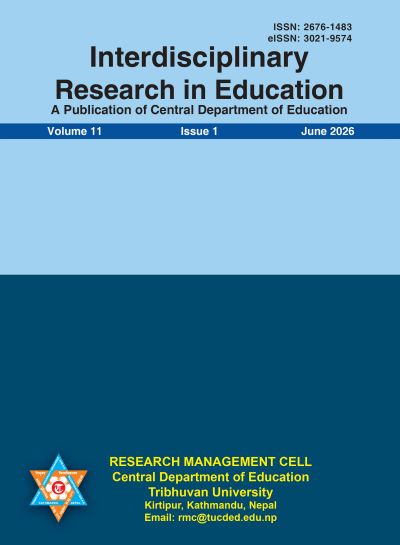
It is great pleasure to us share the issue Vol. 11 No. 1 (2026) of Interdisciplinary Research in Education (IRE) published by Research Management Cell (RMC), Central Department of Education, Tribhuvan University. Continuously, this issue also, included the individual and collaborative articles that expressed various concerns in education.
Mohan Paudel and Ganesh Bahadur Singh jointly expressed their research concern entitled with Enhancing Students' Science Achievement through Teachers' Accountability: A Mixed-Methods Study that teachers play a pivotal role in fostering their students' personal agency and guiding their future development regarding the examine the relationship between teachers' professional accountability and students' science achievement in school education. Jhupa Kumari Budhathoki explored her views on teachers' Participation in the Decision-Making Process at the Higher Education Level that practices of teachers' participation in the decision-making process and also to find out the factors that influence department members’ participation in decision- making. Surya Prasad Adhikari announced the trends of female education at higher levels education is one of the important tools for the development of any nation with examine the trends of female participation in higher education in Nepal.
Similarly, Ran Maya Fyak expressed her research theme entitled Persistent Educational Inequalities among Madhesi Dalit Children in Saptari District, Nepal which also examines educational inequalities among Madhesi Dalit children in the Lokharam community of Chhinnamasta Rural Municipality, Saptari District, Nepal. Toya Nath Adhikari exposed his research concern through Pedagogical Practices in Early Childhood Development: Roles of Facilitators in Community School ECD Centres the pedagogical approaches and instructional techniques us ed by Early Childhood Development (ECD) facilitators in Nepalese community school centres as the main goals were to better understand how facilitators teach young children and to pinpoint the precise tactics used in regular classroom settings. Bal Mukunda Bhandari and Babu Ram Bishwokarma exposed their analytical historical research theme through Analysis of PhD Dissertation Abstracts in the Faculty of Education, specially in English education of Tribhuvan University. According to them Tribhuvan University awarded the first PhD in English Education in 2008 and its on going development in the field of English education regarding the academic Degree. Pratima Tamrakar writes her views through her article entitled Science Teaching Self-Efficacy Among Pre-Service Science Teachers in Nepal: An Insight from the Case Study that science teaching self-efficacy beliefs of pre-service teachers in Nepal, emphasizing their preparedness and confidence in delivering science instruction.
Finally, this issue also, included the Nepali medium article. Khadga Bahadur Shahi and Keshav Bhusal expressed their research concern through an article entitled Madhyamik Tahako Nepali bhashapathyakramma samavishtha bhasik prakarya. In this article they explored the language activities regarding the study of linguistic in the Nepali language curriculum of the secondary level (grades 9 and 10) that analyzed the study of linguistic included in the Nepali language curriculum of the secondary level.
The publication of a journal is a laborious task. The publication of this issue has been possible because of the hardships made by different scholars specially, the scholars that handled the academic and technical effort to manage the task sincerely as recognized by the RMC team. So, we express very sincere best warm wishes and thanks to them. We express our sincere gratitude to the head of the central department of education (T.U.) as the Patron of this journal. Also, we are grateful to authors, reviewers, and editorial team and the members of RMC. The credit goes to the scholars who help and suggest us directly or indirectly with their time and insights by different means. Continuously, we encourage the scholar community contribute to this journal 'Interdisciplinary Research in Education' by providing original and constructive research papers for the next upcoming issues. The views and phenomenon expressed by writers in the corresponding paper are their own concerns and concepts; so, it’s responsibility goes to them correspondingly. RMC editorial board being tried to manage those articles which are authenticate in AI detection and authentic similarity by detecting and plagiarism test. At the end, we highly appreciate the positive and constructive suggestions and feedbacks to enhance the quality of journal in the forthcoming issues.
Downloads
Published
How to Cite
Issue
Section
License
Copyright (c) 2026 Interdisciplinary Research in Education

This work is licensed under a Creative Commons Attribution-NonCommercial 4.0 International License.
This license enables reusers to distribute, remix, adapt, and build upon the material in any medium or format for noncommercial purposes only, and only so long as attribution is given to the creator.


