Editorial Note
Keywords:
n/aAbstract
The current issue of Forestry: Journal of Institute of Forestry, Nepal brings together a diverse and timely set of research papers that collectively illuminate the ecological complexity of Nepal’s forested landscapes and the mounting challenges posed by climate change, land-use dynamics, biodiversity loss, and increasing human pressures. The studies span a wide range of ecological and management contexts from Himalayan treeline ecotones and lowland community forests to sacred groves, urban green spaces, and biodiversity-rich corridors outside protected areas highlighting the needs for science based policy and corss-sectors collaboration.
A major thematic focus of this issue is the role of forests in climate change mitigation and adaptation. Dendrochronological evidence from Abies spectabilis at the treeline ecotone in Mustang offers long-term insights into climate growth relationships and highlights emerging moisture stress under warming conditions. Complementary studies on biomass and carbon stocks in Sal-dominated community forests and Chure-region landscapes quantify above and below ground carbon pools while demonstrating how land-use and land-cover change can gradually erode carbon storage potential. Together, these contributions reinforce the importance of community forests in Nepal’s REDD+ initiatives and broader sustainable forest management strategies.
Biodiversity conservation and forest resilience form another central pillar of this issue. Studies on avifaunal diversity in Lumbini Sacred Garden and the Shantiban urban forest patch illustrate the conservation value of culturally significant and small urban green spaces, while highlighting the influence of human and livestock activities on habitat use. Research from outside protected areas, including habitat correlates of the endangered Himalayan red panda in the Mewa watershed, underscores the urgency of landscape level, participatory conservation approaches. Additional analyses of fire intensity, post-fire regeneration, and regeneration dynamics in sacred forests further emphasize the need for site-specific, science-based management. Collectively, the papers in this issue provide valuable insights for researchers, practitioners, and policymakers working toward resilient forest ecosystems and inclusive conservation practices in Nepal and the broader Himalayan region.
Editorial Board.
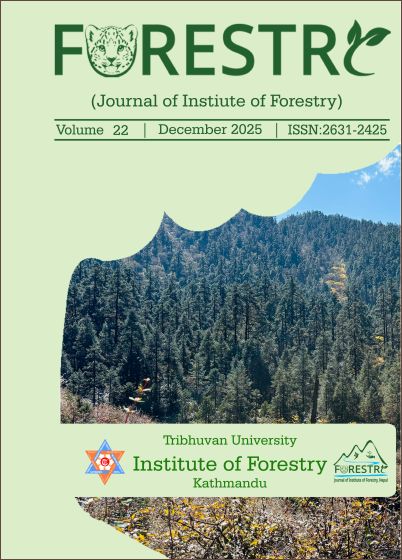
FORESTRY
(Journal of Institute of Forestry, Nepal)
Downloads
Published
Issue
Section
License
Copyright (c) 2025 The Author(s)

This work is licensed under a Creative Commons Attribution 4.0 International License.
This license enables reusers to distribute, remix, adapt, and build upon the material in any medium or format, so long as attribution is given to the creator. The license allows for commercial use.

