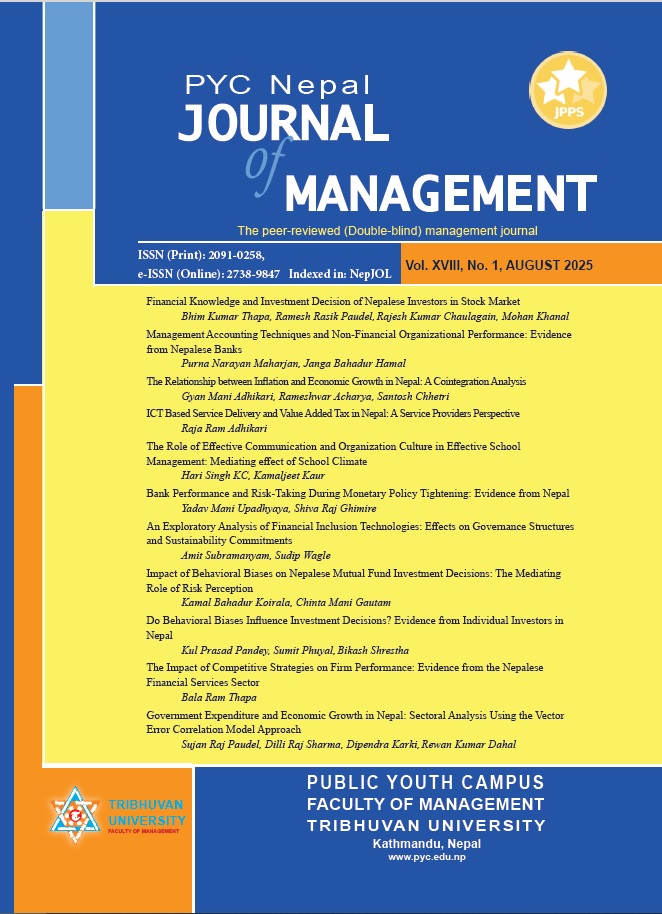
Impact of Behavioral Biases on Nepalese Mutual Fund Investment Decisions: The Mediating Role of Risk Perception
Keywords:
herding, investment, mutual funds, overconfidence, psychological biases, risk perception, herding, investment, mutual funds, overconfidence, psychological biases, risk perceptionAbstract
This study examines how behavioural biases- overconfidence and herding- influence investor choices in Nepalese mutual funds and investigates whether risk perception mediates the relationships between these biases and mutual fund investment decisions. Using a quantitative, explanatory research design, data were systematically collected through survey questionnaires from 386 active market participants, and subsequently analysed in SPSS 27 and RStudio to examine relationships and test hypotheses. The findings indicate that both overconfidence and herding biases significantly and positively drive mutual fund investment choices. Risk perception acts as a mediating factor, partially elucidating the mechanisms through which each bias influences mutual fund investment decisions. The research highlights the need for investor education and behaviour-based strategies to promote better risk awareness and more rational diversified investment choices.
Downloads
Published
How to Cite
Issue
Section
License
© Public Youth Campus

