Editorial Team
Abstract
From the Desk of Editorial Team
With the beginning of the peace process in Nepal since 2005, the hope and expectations of the Nepali people have risen enormously high towards a peaceful, inclusive and prosperous Nepal. Therefore, the newly elected government, and governments that will form after the subsequent general elections under the shortly expected new democratic constitution of the Republic of Nepal will have to face a serious challenge of trading-off between the people’s rising expectations and the efficient delivery of the government. All the political parties have to be aware of this truth and prepare themselves to manage the people’s expectations when they ascend to the helm of the power through the mandate of the Nepali people.
Management has always been a critical constraint to Nepal’s development. No governing bodies, right from the central to the local, achieved desired success in the past, due to the ignorance and neglect of the ‘indispensable’ management system for the efficient delivery of the public good. Therefore, the present government and future governments must have proper management system if they have to show that the governance is in the right direction for the efficient delivery to the public, particularly to those who are deprived and marginalised.
The role of management, therefore, cannot be over-emphasised in any organisation, be it the government, non-government or private organization. Management is a catalyst that enhances the output of any organised effort. It helps to achieve maximum output with minimum inputs through its different principles, techniques and tools. Therefore, a substantial number of research studies have taken place in the recent past, which FROM resulted in introduction of several new and amazing management principles, techniques and tools in all areas of management that have helped in managing organisations, be they mega ones or micro ones, even more effectively and efficiently.
Similarly, many more scientific research studies in management are now being undertaken not only in foreign countries, but also in Nepal; they are expected to produce such principles, techniques and tools that are most suitable and practicable to the native situations. These will further help use the most effective and efficient management system in all the sectors of Nepal’s development. As such, the proposition of ‘New Nepal’ not only remains a slogan but also turns out to be the reality in the years to come. For the ‘dreams come true’, every Nepali’s participation must be ensured and his or her contribution must be accredited and reasonably rewarded.
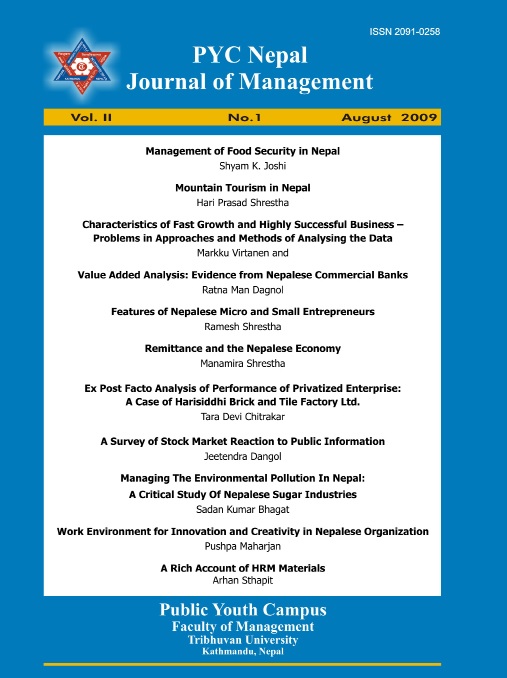
With this noble view in mind and for providing a forum for expression for its young energetic academics and researchers, Public Youth Campus has taken initiation this year to publish an annual journal ‘PYC Nepal Journal of Management – a journal of management and development’, which is presently at the hands of the esteemed readers. Readers’ judgement and verdict about the journal and materials it consists are what we have solicited from them. Since this is the first attempt, several errors and shortcomings have certainly remained undetected. We will certainly try our level best to improve the journal and not to repeat the previous errors in its subsequent publications.
The Editorial Committee
August, 2008
Downloads
Published
How to Cite
Issue
Section
License
© Public Youth Campus

