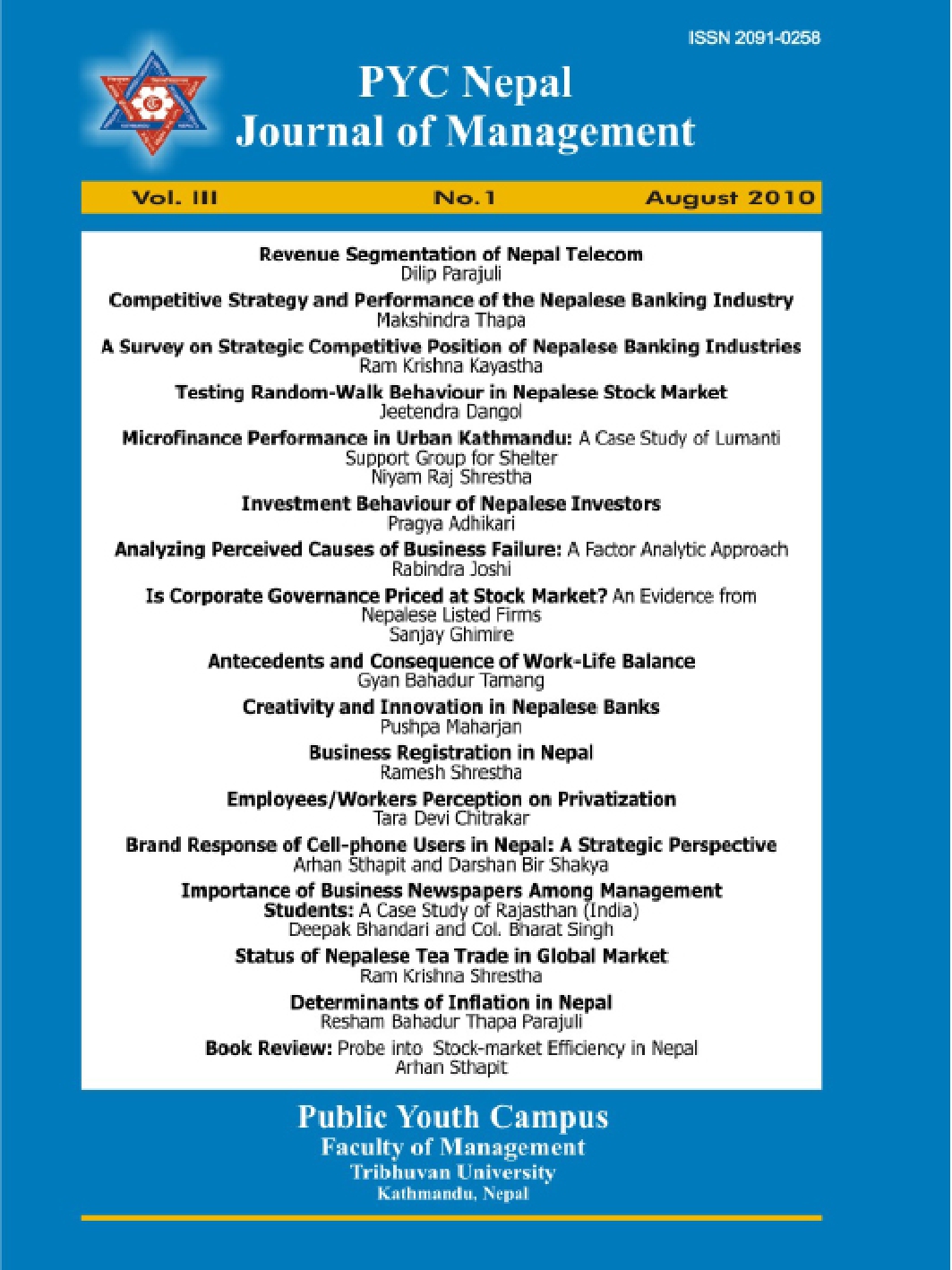
Testing Random-Walk Behaviour in Nepalese Stock Market
Keywords:
random walk, stationary, market efficiency, abnormal returnsAbstract
This paper is originally presented at the “International Seminar on Management” on “Enhancing Enterprise Effectiveness for Global Challenges” organised by Brihaspati College, Siddharthnagar on 3rd and 4th April 2010. The author acknowledges that the printed version of the paper has come after the suggestions from the Editorial Committee.
The paper examines random walk behaviour on daily market returns of the Nepal Stock Exchange (NEPSE) using Augmented Dickey-Fuller (ADF) and Phillips-Perron (PP) unit root tests for the period between July 14, 2000 and January 14, 2010. The study finds that unit root do not exist, and the returns series are stationary. This provides the evidence that the Nepalese stock market does not show characteristics of random walk and thus, it is not efficient in the weak form. It implicates that market participants have opportunities to predict future price and earn abnormal returns from the stock market.
Downloads
Published
How to Cite
Issue
Section
License
© Public Youth Campus

