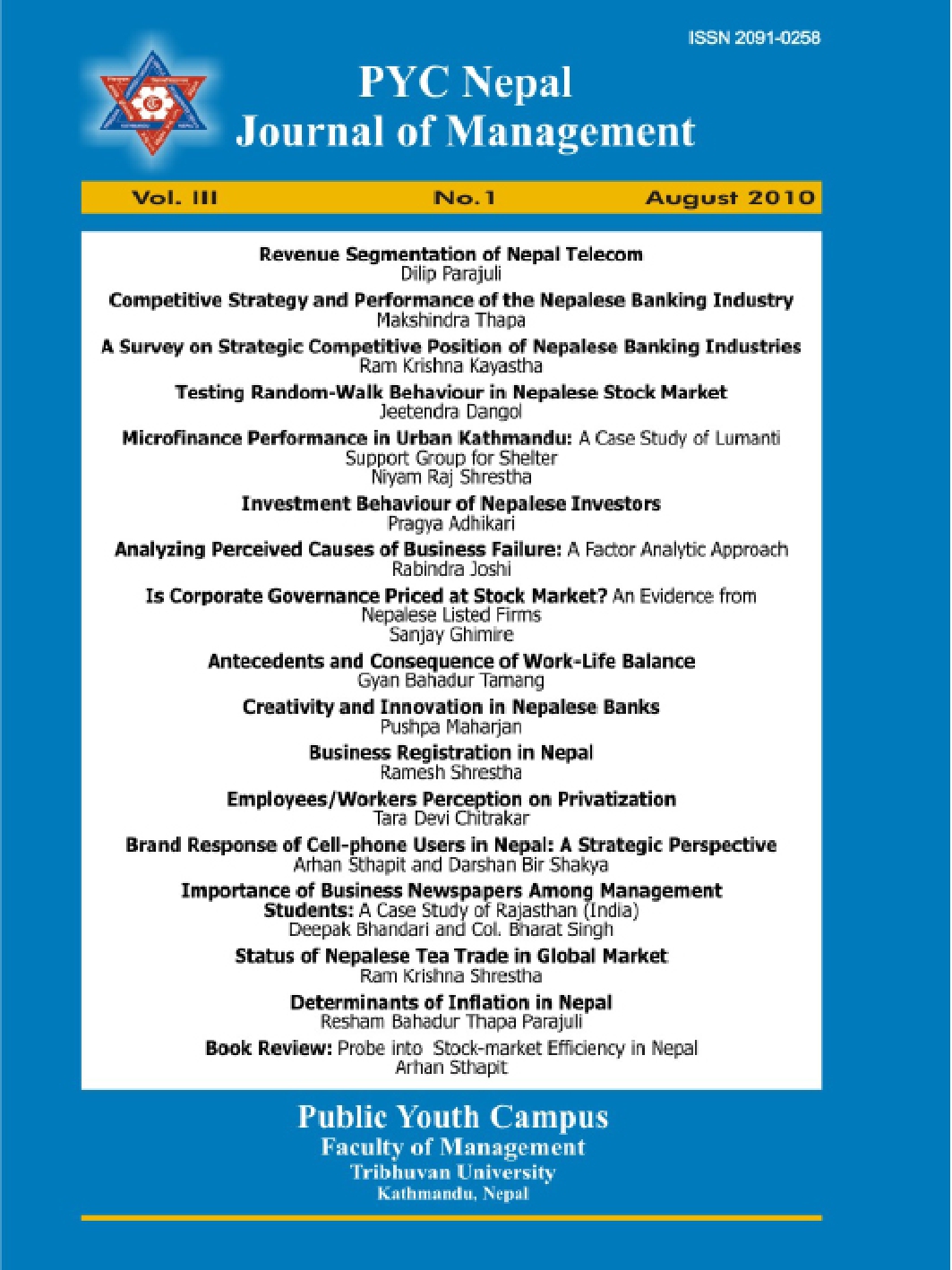
Competitive Strategy and Performance of the Nepalese Banking Industry
Keywords:
competitive strategies, organizational performance, cost leadership, differentiation, banking industry, market-focus strategyAbstract
The Nepalese banking industry has been characterized by strong competition with the continual increase in the number of banks. After the entry of joint venture banks and then the burgeoning of Nepalese private banks with the new definition of and approach to banking, the whole banking industry in general, and the erstwhile monopolist state-owned banks in particular are under the pressure to sustain their competitive position. This situation has, therefore, entailed the Nepalese banks to design and redesign their competitive strategies in a manner to attain higher performance. This paper has sought to empirically look into the strategy--performance relationship in the Nepalese banks. The findings of this study have suggested that there exists a positive relationship between competitive strategies pursued by the banks and their organizational performance. The highest performance seemed to be correlated with cost leadership (cost reduction, operating efficiency and offering competitive prices) strategy, followed by differentiation (in particular through unique and wider range of services offered) strategy, and market-focus strategy respectively. It is further observed that banks have preferred more to pursue the combination of cost-leadership and differentiation strategies than the market-focus strategy to attain their higher performance.
Downloads
Published
How to Cite
Issue
Section
License
© Public Youth Campus

