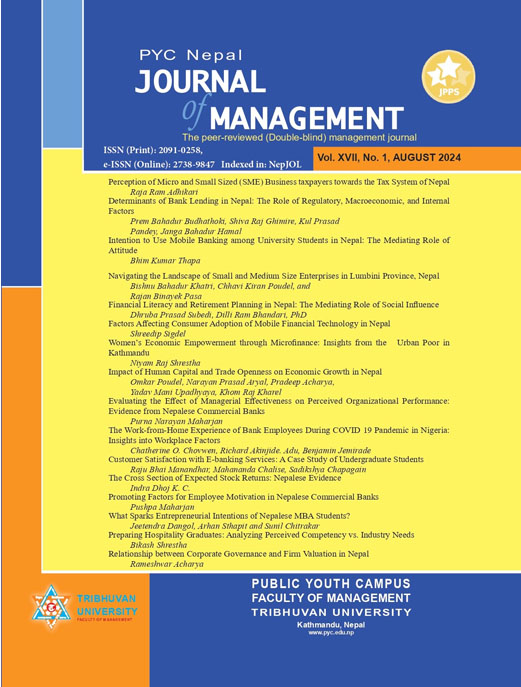
Impact of Human Capital and Trade Openness on Economic Growth in Nepal
Keywords:
economic growth, human capital, trade openness, labour force participationAbstract
This study investigates the impact of human capital and trade openness on Nepal’s economic growth, addressing a gap in research on their dynamic relationship. Using time series data from 1991 to 2023, the study applies the dynamic ordinary least squares (DOLS) co-integration method, which is well-suited for addressing endogeneity and small sample bias. The key variables analyzed include GDP per capita, trade openness, tertiary education, labour force participation, urban population, and total population. The findings reveal that both trade openness and human capital significantly contribute to long-term economic growth in Nepal. Trade openness facilitates technological transfer and market expansion, positively impacting GDP. Human capital, represented by education and labour force participation, enhances productivity and income. However, the effects of labour force participation are complex and context dependent. These results emphasize the critical role of human capital and trade openness in driving Nepal’s economic progress. Policymakers should prioritize trade liberalization and invest in targeted educational and vocational programs to strengthen human capital. Future research could explore the role of technology, infrastructure, and sector-specific policies in optimizing the benefits of human capital and trade openness in developing economies like Nepal.
Downloads
Published
How to Cite
Issue
Section
License
© Public Youth Campus

