Population status and spatiotemporal distribution of greater and lesser flamingos in Gulf of Mannar Lagoons, Tamil Nadu, India
Keywords:
Biodiversity hotspots, Flamingo sanctuary, Lagoon, Population estimate, Rameshwaram, WetlandAbstract
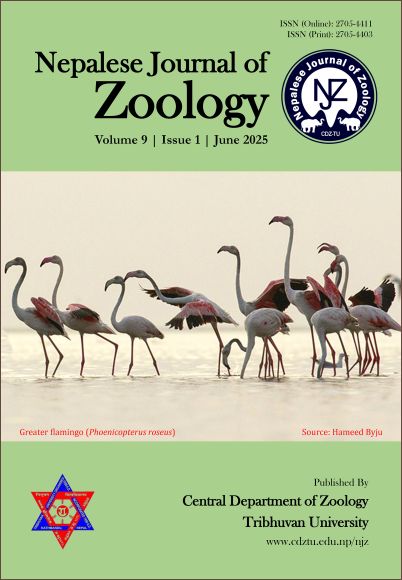
Flamingos are the most widespread among other species of Phoenicopteridae. This study examines the spatiotemporal distribution and population status of greater flamingos Phoenicopterus roseus and lesser flamingos Phoeniconaias minor in Tamil Nadu. We used systematic monthly survey data (2020–2024) at Valinokkam and Kothandaramar Lagoons in the Gulf of Mannar region, and a decade-long eBird dataset (2014–2024) and compared them with available historical data. Standardized morning surveys (6:00–10:00 hours) and point-count methods were employed, with GIS mapping to analyze distribution patterns. For greater flamingos, 22 key sites met strict criteria (≥5 years of data, ≥20 individuals/year), while lesser flamingo sites required ≥10 individuals in any year. Results revealed peak congregations (6,040–7,200 flamingos) in February–March at the two lagoons, aligning with optimal foraging conditions in receding wetlands. Greater flamingos were widely distributed, with major populations in Point Calimere (peak: 15,000), Pulicat Lake, and saltpans (200–500 individuals), showing 40% peak abundance in November–February in the eBird dataset. Point Calimere, Pulicat Lake, Valinokkam and Kothandaramar Lagoons also support the 1% global population of greater flamingo. In contrast, lesser flamingos were restricted primarily to Pulicat Lake (max: 800). Key threats include habitat loss from saltpan expansion, pollution, and aquaculture. The findings emphasize the importance of coastal wetlands and managed saltpans for flamingo conservation, advocating for integrated protection of critical sites and sustainable land-use practices. This study is important as the Tamil Nadu Forest Department has recently declared Dhanushkodi/Kothandaramar Lagoon as the first flamingo sanctuary in the state.
Downloads
Published
How to Cite
Issue
Section
License

This work is licensed under a Creative Commons Attribution-NonCommercial 4.0 International License.
This license enables reusers to distribute, remix, adapt, and build upon the material in any medium or format for noncommercial purposes only, and only so long as attribution is given to the creator.

