
Submissions

Login or Register to make a submission.

Submission Preparation Checklist

As part of the submission process, authors are required to check off their submission's compliance with all of the following items, and submissions may be returned to authors that do not adhere to these guidelines.
  • The submission has not been previously published, nor is it before another journal for consideration (or an explanation has been provided in Comments to the Editor).
  • The submission file is in Microsoft Word file format.
  • Where available, DOIs for the references have been provided.
  • The text is 1.5 line-spaced; uses Times New Roman 12-point font; employs italics, rather than underlining (except with URL addresses); and all illustrations, figures, and tables are placed within the text at the appropriate points, rather than at the end.
  • The text adheres to the stylistic and bibliographic requirements outlined in the Author Guidelines.

Author Guidelines

The journal accepts the following manuscript types:

Manuscript Preparation

Language
All manuscripts must be written in clear, grammatically correct English (British or American, applied consistently throughout). Authors whose first language is not English are strongly encouraged to have their manuscript proofread by a native English speaker or a professional editing service before submission.

File Format
Submit manuscripts as a Microsoft Word document (.doc or .docx) using the official JIETM Paper Template.
Do not submit PDFs as the primary manuscript file.

Page Layout & Formatting
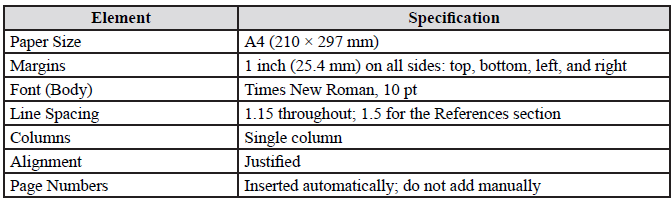
The following formatting specifications must be observed throughout the manuscript:

Title
Font: Times New Roman, 13 pt, Bold.
Capitalize the first letter of each major word. Articles (a, an, the), conjunctions, and prepositions should be in lowercase unless they begin the title. The title should be concise yet descriptive (typically 12–20 words). Avoid abbreviations, jargon, and formulae in the title.

Author Information

  • Author names: Times New Roman, 12 pt. List in the order of contribution.
  • Affiliations: Times New Roman, 8 pt, italics include department, institution, city, and country.
  • Email addresses: include for all authors; designate one corresponding author with an asterisk (*).

Abstract
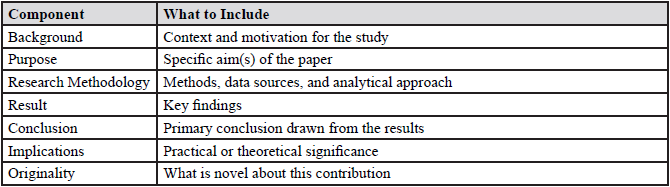
The abstract must be a single paragraph of 150–250 words written in Times New Roman, 9 pt. It must be structured using the following labeled components (bold labels, followed by the text in the same paragraph):

Keywords
Provide 4–8 keywords separated by semicolons (;) immediately after the abstract. Keywords should reflect the paper's core topics and aid discoverability. Avoid keywords that merely repeat words in the title.

Article Structure
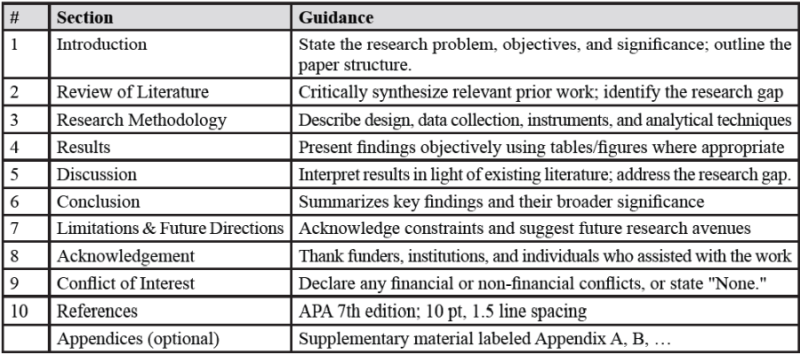
Manuscripts should follow the structure below. Section headings must be numbered, bold, and 10 pt. Subsection headings should be numbered (e.g., 1.1, 1.2), bold-italic, and 10 pt.

Tables

  • All tables must be numbered consecutively with Arabic numerals (Table 1, Table 2, …).
  • Table titles are placed above the table, centered, Times New Roman 8 pt.
  • Leave one blank line between the title and the table body.
  • Use only vertical lines to delineate columns; add horizontal rules above and below the table and between the header row and data rows. Avoid heavy or decorative borders.
  • Tables must be embedded within the text, positioned as close as possible to their first citation.
  • Font size inside tables: 8 pt, Times New Roman.
  • Avoid tables that merely replicate information presented in the text.

Figures

  • All figures, diagrams, graphs, and sketches must be numbered consecutively with Arabic numerals (Figure 1, Figure 2, …).
  • Figure captions are placed below the figure, centered, 8 pt, Times New Roman.
  • Line drawings must be of high quality, either produced electronically or scanned at a minimum resolution of 300 dpi. Poor-quality scans will not be accepted.
  • Embed figures directly into the manuscript; do not submit them as separate files.
  • Ensure all lettering and symbols are legible and explained in the caption or a legend within the figure.
  • Position figures at the top or bottom of a page, as close as possible to their first mention in the text.
  • Color figures are accepted; ensure they are also interpretable in greyscale.

Equations & Formulae

  • Type all equations in Microsoft Word's Equation Editor or MathType.
  • Number equations consecutively with Arabic numerals in parentheses, right-aligned (e.g., (1), (2), …), only where equations are explicitly cited in the text.
  • Refer to equations in the text as Equation (1), Equation (2), etc.
  • Define all symbols and variables immediately following the equation in which they first appear.

References
JIETM uses APA 7th Edition for all citations and the reference list. References must be listed at the end of the paper in the order they appear in the text (not alphabetically), formatted in Times New Roman, 10 pt, with 1.5 line spacing.

In-text Citations

  • Single author: (Smith, 2020)
  • Two authors: (Smith & Jones, 2020)
  • Three or more authors: (Smith et al., 2020)
  • Direct quotation: include page number (Smith, 2020, p. 45)

Common Reference Formats

Journal article:
Author, A. A., & Author, B. B. (Year). Title of article. Journal Name, Volume(Issue), Page–Page. https://doi.org/xxxxx

Book:
Author, A. A. (Year). Title of work: Capital letter also for subtitle. Publisher.

Book chapter:
Author, A. A. (Year). Title of chapter. In E. E. Editor (Ed.), Title of book (pp. xx–xx). Publisher.

Include a DOI or stable URL for all online sources where available. Personal communications and unpublished data should be cited in the text only and not listed in the reference list.

Ethical Requirements

Originality & Plagiarism
All manuscripts submitted to JIETM must be original and must not have been published, or be under consideration for publication, elsewhere (including conference proceedings, unless substantially revised and extended). Authors are responsible for ensuring their work does not infringe any copyright.

JIETM screens all submissions for plagiarism. A similarity index of more than 15% (excluding references and quotations) will result in immediate rejection or a request for substantial revision.

Authorship
All listed authors must have made a substantial contribution to the conception, design, data collection, analysis, interpretation, or drafting of the manuscript, and must have approved the final version. Honorary or guest authorship is not acceptable.

Data Availability
Authors are encouraged to make the research data underlying their findings available in a recognized public repository. Where data cannot be shared, a brief justification should be included in the manuscript.

Research Involving Human Participants
Studies involving human participants, personal data, or identifiable records must comply with applicable ethical standards (e.g., institutional review board approval). They must include a statement confirming ethical approval and informed consent in the manuscript.

Conflict of Interest
All authors must disclose any financial or personal relationships that might influence the research. If no conflict exists, include the statement: "The authors declare no conflict of interest."

Submission Process

Required Submission Files

  • Main manuscript file anonymized, following the JIETM template (.doc or .docx)
  • Title page separate file with full author names, affiliations, and contact details
  • Cover letter addressed to the Editor-in-Chief; briefly describe the paper's contribution and confirm it has not been submitted elsewhere
  • Figures: high-resolution images embedded in the manuscript; provide separate files (TIFF/EPS/PNG, ≥ 300 dpi) if requested
  • Ethical approval document (if applicable)

Blind Review Policy
JIETM operates a double-masked peer review process. The main manuscript file must be completely anonymized: remove all author names, affiliations, and any identifying acknowledgments before submission. Author details should appear only on the separate Title Page.

Manuscript Status
Corresponding authors will receive an acknowledgment of receipt within 5 working days. Authors may check the status of their submission by contacting the editorial office. The typical turnaround time from submission to first decision is 6–8 weeks.

Peer Review & Revision
All submissions undergo initial editorial screening for scope and formatting compliance before being sent for peer review. A minimum of two independent experts evaluate manuscripts that pass initial screening. Authors will receive one of the following decisions:

  • Accept: manuscript is accepted as submitted (minor copyediting may follow)
  • Minor Revision: revisions required; re-review is typically not necessary
  • Major Revision: substantial revisions required; revised manuscript will be re-reviewed
  • Reject: manuscript does not meet the journal's standards for publication

When submitting a revised manuscript, authors must include a point-by-point Response to Reviewers document detailing how each comment has been addressed (or a justification for not making a requested change).

Proofs & Publication
Upon acceptance, manuscripts are copyedited and typeset by the JIETM production team. PDF proofs will be sent to the corresponding author for review. Authors should check proofs carefully for typographical errors; no substantive changes to the content are permitted at the proof stage. Corrected proofs must be returned within 48 hours.

Accepted articles are published in the earliest available issue of JIETM and assigned a volume, issue number, and page range (e.g., Volume 1, Issue 1, May 2026).

Contact & Further Information
Authors with questions about submission requirements, manuscript status, or editorial policy should contact the editorial office. Please cite your manuscript reference number in all correspondence.

JIETM Editorial Office
Himalayan Whitehouse International College
Putalisadak
Kathmandu, Nepal
ISSN: 3149-7144
eISSN: 3149-7152
Volume X, Issue Y - Year

Pre-Submission Checklist

  • Manuscript uses the official JIETM template (Times New Roman, 10 pt body, 1.15 line spacing)
  • Title in 13 pt Bold TNR; author names 12 pt; affiliations 8 pt italics
  • Abstract is 150–250 words and includes all seven structured components
  • 4–8 keywords provided, separated by semicolons
  • Sections numbered and ordered correctly (Introduction → … → References)
  • All tables numbered, titled above, 8 pt TNR, embedded in text
  • All figures numbered, captioned below, 8 pt TNR, high-resolution, embedded
  • Equations typed in Equation Editor, numbered in parentheses where cited
  • All references in APA 7th edition format, 10 pt, 1.5 line spacing
  • Similarity/plagiarism index below 15%
  • Main manuscript file fully anonymized (no author names or affiliations)
  • Separate Title Page file prepared with full author details
  • Cover letter prepared and addressed to Editor-in-Chief
  • Conflict of interest statement included
  • Ethical approval statement included (if applicable)

Thank you for contributing to JIETM. We look forward to receiving your submission.

Privacy Statement

Nepal Journals Online (NepJOL) is a member of the Ubiquity Partner Network coordinated by Ubiquity Press. According to the EU definitions, NepJOL is the data controller, and Ubiquity Press are the service providers and data processors. Ubiquity Press provide the technical platform and some publishing services to NepJOL and operate under the principle of data minimisation where only the minimal amount of personal data that is required to carry out a task is obtained.

More information on the type of data that is required can be found in Ubiquity Press’ privacy policy below.

Ubiquity Press Privacy Policy

We take seriously our duty to process your personal data in a fair and transparent way. We collect and manage user data according to the following Privacy Policy. This document is part of our Terms of Service, and by using the press portal, affiliated journals, book, conference and repository websites (the “Websites”), you agree to the terms of this Privacy Policy and the Terms of Service. Please read the Terms of Service in their entirety, and refer to those for definitions and contacts.

What type of personal data do we handle?

There are four main categories of personal data stored by our journal platform, our press platform, and our book management system; Website User data, Author data, Reviewer data and Editor data.

The minimum personal data that are stored are:

  • full name
  • email address
  • affiliation (department, and institution)
  • country of residence

Optionally, the user can provide:

  • salutation
  • gender
  • associated URL
  • phone number
  • fax number
  • reviewing interests
  • mailing address
  • ORCiD
  • a short biography
  • interests
  • Twitter profile
  • LinkedIn profile
  • ImpactStory profile
  • profile picture

The data subjects have complete control of this data through their profile, and can request for it to be removed by contacting info@ubiquitypress.com

What do we do to keep that data secure?

We regularly backup our databases, and we use reliable cloud service providers (Amazon, Google Cloud, Linode) to ensure they are kept securely. Backups are regularly rotated and the old data is permanently deleted. We have a clear internal data handling policy, restricting access to the data and backups to key employees only. In case of a data breach, we will report the breach to the affected users, and to the press/journal contacts within 72 hours.

How do we use the data?

Personal information is only used to deliver the services provided by the publisher. Personal data is not shared externally except for author names, affiliations, emails, and links to ORCiD and social media accounts (if provided) in published articles and books which are displayed as part of the article/book and shared externally to indexes and databases. If a journal operates under open peer review then the reviewer details are published alongside the reviewer details.

How we collect and use your data:

1. When using the website

1.1 what data we collect

  • When you browse our website, we collect anonymised data about your use of the website; for example, we collect information about which pages you view, which files you download, what browser you are using, and when you were using the site.
  • When you comment on an article or book using Disqus, we are not collecting, controlling or processing the data. More details on the DISQUS privacy policy can be found on their website.
  • When you annotate an article or book, this is done via a 3rd party plugin to the website called Hypothes.is. In using this plugin we are not collecting, controlling or processing the data. More details on the Hypothes.is privacy policy can be found on their website.

1.2 why we collect the data

  • We use anonymised website usage data to monitor traffic, help fix bugs, and see overall patterns that inform future redesigns of the website, and provide reports on how frequently the publications on our site have been accessed from within their IP ranges.

1.3 what we do (and don’t do) with the data

  • We do not collect personal information that can be used to identify you when you browse the website.
  • We currently use Google Analytics for publication reports, and to improve the website and services through traffic analysis, but no personal identifying data is shared with Google (for example your computer’s IP is anonymised before transmission).

1.4 what to do if you want to get a copy of your data, or want your data to be removed

  • Please contact info@ubiquitypress.com to request a copy of your data, or for your data to be removed/anonymised.

2. When registering as an author, and submitting an article or book

2.1 what data we collect

  • When registering an account we ask you to log in and provide certain personal information (such as your name and email address), and there is the option to register using an ORCiD which will pre-fill the registration form.
  • As part of submitting an article for publication, you will need to provide personally identifying information which will be used for the peer review process, and will be published. This can include ‘Affiliation’, ‘Competing interests’, ‘Acknowledgements’.

2.2 why we collect the data

  • Registering an account allows you to log in, manage your profile, and participate as an author/reviewer/editor. We use cookies and session information to streamline your use of the website (for example in order for you to remain logged-in when you return to a journal). You can block or delete cookies and still be able to use the websites, although if you do you will then need to enter your username and password to login. In order to take advantage of certain features of the websites, you may also choose to provide us with other personal information, such as your ORCiD, but your decision to utilize these features and provide such data will always be voluntary.
  • Personal data submitted with the article or book is collected to allow follow good publication ethics during the review process, and will form part of the official published record in order for the provenance of the work to be established, and for the work to be correctly attributed.

2.3 what we do (and don’t do) with the data

  • We do not share your personal information with third parties, other than as part of providing the publishing service.
  • As a registered author in the system you may be contacted by the journal editor to submit another article.
  • Any books published on the platform are freely available to download from the publisher website in PDF, EPUB and MOBI formats on the publisher’s site.
  • Any personal data accompanying an article or a book (that will have been added by the submitting author) is published alongside it. The published data includes the names, affiliations and email addresses of all authors.
  • Any articles published on the platform are freely available to download from the publisher website in various formats (e.g. PDF, XML).
  • Ubiquity Press books and articles are typeset by SiliconChips and Diacritech.This process involves them receiving the book and book associated metadata and contacting the authors to finalise the layout. Ubiquity Press work with these suppliers to ensure that personal data is only used for the purposes of typesetting and proofing.
  • For physical purchases of books on the platform Ubiquity Press use print on demand services via Lightning Source who are responsible for printing and distribution via retailers. (For example; Amazon, Book Repository, Waterstones). Lightning Source’s privacy policy and details on data handling can be found on their website.

2.4 why we store the data

  • We store the account data so that you may choose to become a reviewer and be able to perform those tasks, or to become an author and submit an article and then track progress of that article.
  • Published personal data that accompanies an article or a book forms part of the official published record in order for the provenance of the work to be established, and for the work to be correctly attributed.

2.5 what to do if you want to get a copy of your data, or want your data to be removed

  • You are able to view, change and remove your data associated with your profile. Should you choose to completely delete your account, please contact us at support@ubiquitypress.com and we will follow up with your request as soon as possible.
  • To conform to publication ethics and best practice any personal data that is published alongside an article or book cannot be removed. If you have a query about a publication to which you are attributed please contact info@ubiquitypress.com

3. When registering as a reviewer

3.1 what data we collect

  • To become a reviewer you must first register as a user on the website, and set your preference that you would like to be considered as a reviewer. No new personal data is collected when a registered user elects to become a reviewer.
  • When registering an account we ask you to log in and provide certain personal information (such as your name and email address), and there is the option to register using an ORCiD which will pre-fill the registration form.
  • Reviewers can also be registered by editors who invite them to review a specific article. This requires the editor to provide the reviewer’s First Name, Last Name, and Email address. Normally this will be done as part of the process of inviting you to review the article or book.
  • On submitting a review, the reviewer includes a competing interest statement, they may answer questions about the quality of the article, and they will submit their recommendation.

3.2 why we collect the data

  • The data entered is used to invite the reviewer to peer review the article or book, and to contact the reviewer during and the review process.
  • If you submit a review then the details of your review, including your recommendation, your responses to any review form, your free-form responses, your competing interests statement, and any cover letter are recorded.

3.3 what we do (and don’t do) with the data

  • This data is not shared publicly and is only accessible by the Editor and system administrators of that journal or press.
  • The data will only be used in connection with that journal or press.
  • Data that is retained post final decision is kept to conform to publication ethics and best practice, to provide evidence of peer review, and to resolve any disputes relating to the peer review of the article or book.
  • For journals or presses that publish the peer reviews, you will be asked to give consent to your review being published, and a subset of the data you have submitted will become part of the published record.

3.4 what to do if you want to get a copy of your data, or want your data to be removed

  • If you would no longer like to be registered as a reviewer you can edit your profile and tick the box ‘stop being a reviewer’. This will remove you from the reviewer database, however any existing reviews you may have carried out will remain.
  • If you have been contacted by an editor to peer review an article this means that you have been registered in the system. If you would not like to be contacted for peer review you can reply to the email requesting that your data be deleted.

4. When being registered as a co-author

4.1 what data we collect

  • Co-author data is entered by the submitting author. The submitting author will already have a user account. According to standard publishing practice, the submitting author is responsible for obtaining the consent of their co-authors to be included (including having their personal data included) in the article/book being submitted to the journal/press.
  • The requested personal data for co-authors are at the bare minimum; first name, last name, institution, country, email address. This can also include; ORCID ID, Title, Middle Name, Biographical Statement, Department, Twitter Handle, Linkedin Profile Name or ImpactStory ID.

4.2 why we collect the data

  • Assuming that it is accepted for publication, this data forms part of the official published record in order for the provenance of the work to be established, and for the work to be correctly attributed.
  • Author names, affiliations and emails are required for publication and will become part of the permanent cited record.

4.3 what we do (and don’t do) with the data

  • The co-author’s personal data is stored in the author database. This personal data is only used in relation to the publication of the associated article.
  • Any co-author data collected is added to the author database and is only used in association with the article the user is co-author on.

4.5 what to do if you want to get a copy of your data, or want your data to be removed

  • To receive a copy of your data, please contact info@ubiquitypress.com
  • To conform to publication ethics and best practice any personal data that is published alongside an article or book cannot be removed. If you have a query about a publication to which you are attributed please contact info@ubiquitypress.com

5. When signing-up to receive newsletters

5.1 what data we collect

  • We require you to include your name and email address

5.2 why we collect and store the data, and for how long

  • This data would be collected to keep you updated with any news about the platform or specific journal

5.3 what we do (and don’t do) with the data

  • We use mailchimp to provide our mailing list services. Their privacy policy can be found here

5.4 what to do if you want to get a copy of your data or want your data to be removed

  • All emails sent via our newsletter client will include a link that will allow you to unsubscribe from the mailing list

Notification about change of ownership or of control of data

We may choose to buy or sell assets. In the case that control of data changes to or from Ubiquity Press and a third party, or in the case of change of ownership of Ubiquity Press or of part of the business where the control of personal data is transferred, we will do our best to inform all affected users and present the options.

(Updated: 1 June 2026)
