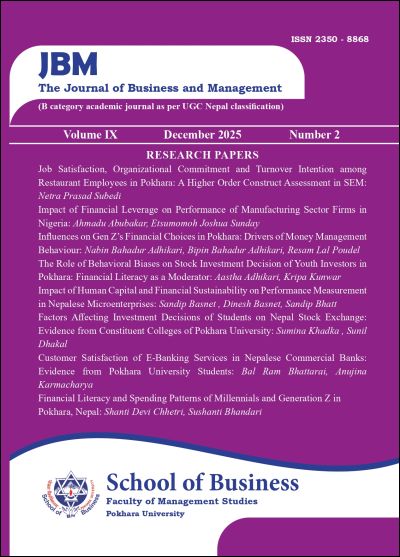
Impact of Human Capital and Financial Sustainability on Performance Measurement in Nepalese Microenterprises
Keywords:
Microenterprises, sustainability indicators, performance measurement, entrepreneurial motivation, profitabilityAbstract
Background: Microenterprises (MEs) play an important role in creating employment and livelihood diversification in Nepal; however, they are facing persistent challenges in various aspects of management. Most of the studies on microenterprises often focus on larger SMEs, overlooking the unique constraints of microenterprises, particularly their limited resources, informal structure, and weak human capital capabilities. Hence, there is an instant need to analyze how motivation, skills, innovation, and profitability influence performance measurement within Nepalese microenterprises to aid in developing more appropriate frameworks for sustainability and development programs.
Objectives: The aim of this study is to examine the impact of motivation, skills, innovation, and profitability on the performance measurement of Nepalese microenterprises (MEs) and to determine ways of improving their development process.
Methods: This study adopted a single reality and positivist epistemology. This research incorporated descriptive and causal research designs. A structured questionnaire was utilized to gather primary data from 124 employees working in microenterprises (MEs). Descriptive and inferential analyses were done. A multiple linear regression models were utilized to test the hypotheses.
Results: The analysis revealed that motivation, skills, and profitability positively impact the performance measurement and account for 91.5% of the variance. On the other hand, the absence of innovation is noted. Hence, enhancing financial practices coupled with employee motivation and entrepreneurial skills can significantly advance MEs’ performance in Nepal.
Conclusion: Policymakers and development organizations could concentrate on the potential of customized training programs, incentive structures, and personalized financial management measures to enhance microenterprise resilience and promote sustainable economic growth. Sustainability dimensions (motivation, skills, and profitability) are essential for performance measurement, but they are less prioritized in the Nepalese context.
Implication: The Nepalese microenterprises could consider the dominant factors for better performance. Moreover, this study suggested that motivation, skills, and profitability play a significant role in enhancing performance in the Nepalese microenterprises sector. With the help of this study, the decision maker and the researchers could identify the sustainable dimensions and the root causes for better performance.
Downloads
Published
Issue
Section
License
Copyright © the School of Business. All rights reserved. No part of this volume may be reproduced or utilized in any form or by any means, electronic or mechanical, including photocopying, recording, or by and information storage and retrieval system, without permission in writing from the publisher.

