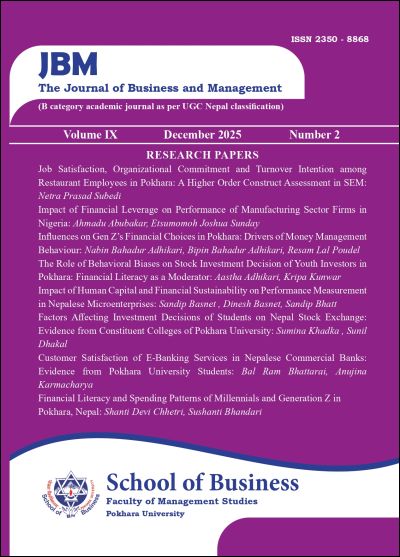
The Role of Behavioral Biases on Stock Investment Decision of Youth Investors in Pokhara: Financial Literacy as a Moderator
Keywords:
Anchoring bias, behavioral biases, herding behavior, loss aversion, overconfidence biasAbstract
Background: Behavioral finance recognizes the effect of psychology and emotions in decision-making, in contrast with the concept of traditional finance that distorts the investor’s rationality, and hampers market efficiency.
Objectives: The purpose of the study is to investigate the impact of behavioral biases in investment decisions. It furthermore examines the moderating effect of financial literacy.
Methods: This study allowed the convenience sampling method and collects the data from 202 respondents using a structured questionnaire conducting a survey. Similarly, the multiple regression model was employed to examine the impact of behavioral biases in investment decisions and the moderating effect of financial literacy.
Results: The study claimed that both overconfidence bias (β = .24, p < .001) and anchoring bias (β = .32, p < .001) have a positive impact, while herding behavior (β = -.20, p < .001) has a negative impact on investment decisions of youths. However, loss aversions (β = .05, p = .442) appear insignificant on investment decisions. In addition, this study established that financial literacy (β = -0.82, p < .05) moderates the relationship between overconfidence bias and investment decisions, effectively decreasing the effect of overconfidence bias.
Conclusions: Youth investors appear overconfident about their financial skills and self-judgments, as well as rely more on initial and outdated information in investment decisions-making. Likewise, investors who follow herd mentality would not be able to make informed decisions in the market. Additionally, financial literacy appeared as a strong moderator, which helps to reduce the negative impact of overconfidence bias on investment decisions. This study enriches academic literature and offers significant implications to the stakeholders.
Downloads
Published
How to Cite
Issue
Section
License
Copyright © the School of Business. All rights reserved. No part of this volume may be reproduced or utilized in any form or by any means, electronic or mechanical, including photocopying, recording, or by and information storage and retrieval system, without permission in writing from the publisher.

