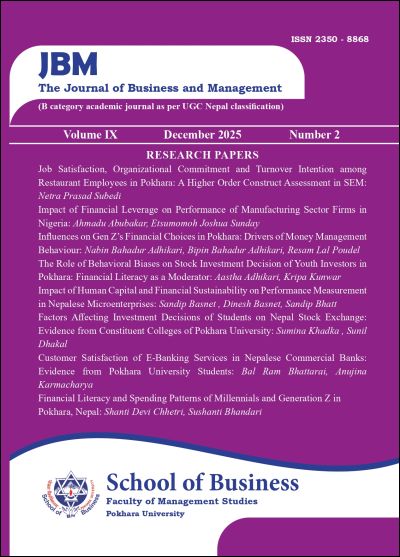
Impact of Financial Leverage on Performance of Manufacturing Sector Firms in Nigeria
Keywords:
Financial leverage, financial performance, manufacturing firms, NigeriaAbstract
Background: Manufacturing sector is known as a catalyst for development, globally. However, in Nigeria, the performance of the sector has shown a declining trend so far. Additionally, evidence from the theory and empirical predictions on the possible relationship between leverage and performance are unclear and mixed, which calls for more empirical studies.
Objectives: Impact of financial leverage on performance was investigated, drawing from listed firms in the manufacturing sector of Nigeria.
Methods: Ex-post facto and longitudinal designs are used. We collected from the yearly reports and financial statements, data of 25 firms from 2011 to 2023. Descriptive statistics and the static panel methods are employed to analyse the data collected.
Results: The main findings from the best panel estimator- fixed effects model, reveal that debt ratio negatively impacts performance; debt-to-equity ratio positively impacts performance, and interest coverage ratio has a positive but insignificant impact on performance, proxy with earnings per share. The findings also reveal an existence of non-linear connection binding debt ratio with performance. For the link binding debt-to-equity ratio to the performance, a non-linear relationship in the form of inverted U-shape was discovered.
Conclusion: High component of debt in the financial structure of firms diminish performance. This is because the cost related to debt financing is fixed and huge. Firms should reduce over-reliance on debt financing, since it has the capacity to erode earnings and performance, if it not well managed. Manufacturing firms may adopt an appropriate mix of debt with equity to match the costs of debt with its benefits.
Implication: High borrowing costs may exacerbate the negative impact of excessive debt on firm performance. Policymakers and financial regulators may therefore promote financial market reforms that reduce lending rates and expand access to structured financing instruments. Additionally, regulatory bodies such as the Nigerian Exchange Group (NGX) may encourage better disclosure and monitoring of firms’ capital structure positions to enhance transparency and investor confidence.
Downloads
Published
How to Cite
Issue
Section
License
Copyright © the School of Business. All rights reserved. No part of this volume may be reproduced or utilized in any form or by any means, electronic or mechanical, including photocopying, recording, or by and information storage and retrieval system, without permission in writing from the publisher.

