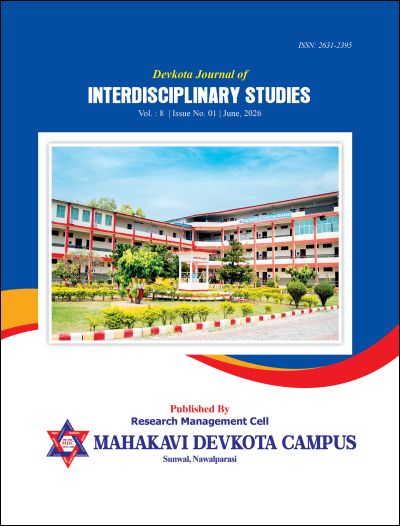
Evaluating English Language Learning through a Non-Credit Course: A CIPP Model Study in Higher Education
Keywords:
Non-credit course, English language acquisition, CIPP evaluation model, communicative language learning, higher education, supplementary language programsAbstract
English language proficiency is increasingly recognized as an essential skill for academic success and professional advancement in higher education. However, many university students continue to experience difficulties in developing effective communicative competence through traditional credit-based courses alone. This study evaluates the effectiveness of a Non-Credit English Language Course implemented at Mahakavi Devkota Campus, Sunwal, Nepal, to improve students’ language acquisition. The research employed a quasi-experimental mixed-method design involving 25 bachelor-level students. Quantitative data were collected through pre-tests and post-tests, while qualitative insights were obtained through semistructured interviews and document analysis. The evaluation was guided by the CIPP (Context, Input, Process, and Product) model developed by Daniel L. Stufflebeam. The findings indicate that the non-credit course provided a supportive and interactive learning environment that encouraged active participation and practical language use. Students demonstrated improvement in their post-test performance and reported increased confidence in speaking English. The study suggests that supplementary non-credit language programs can serve as an effective complement to traditional language instruction, particularly in community-based higher education institutions where students may have limited exposure to communicative English.