Titanium Elastic Nailing System in Treatment of Fracture Shaft of Tibia in Children and Adolescents: A Prospective Observational Study
Keywords:
Titanium Elastic Nailing System (TENS), pediatric tibial fractures, Flynn’s criteria, radiological union, limb length discrepancyAbstract
BACKGROUND
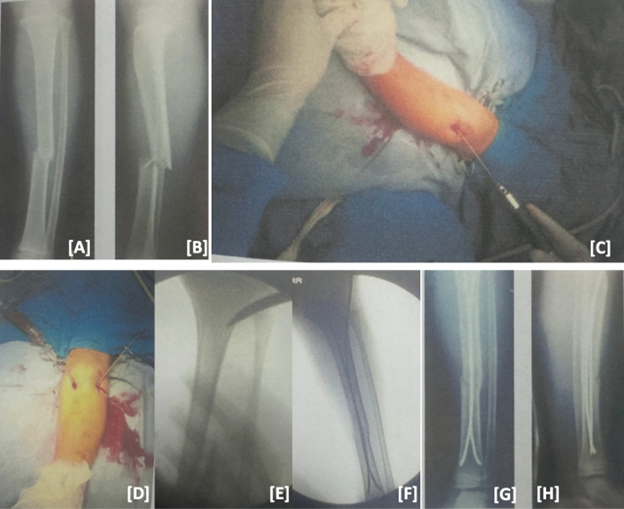
Tibial shaft fractures are common pediatric injuries, often requiring surgical intervention when conservative management fails. The Titanium Elastic Nailing System (TENS) has gained popularity due to its minimally invasive nature, stable fixation, and ability to preserve growth plates. This study evaluates the functional and radiological outcomes of pediatric tibial shaft fractures treated with TENS in a resource-limited setting.
METHODS
A prospective observational study was conducted at the National Level Tertiary Care Trauma Center in Nepal, from February 2019 to January 2020. Forty-six patients aged 5–18 years with unstable tibial shaft fractures were treated with TENS. Functional outcomes were assessed using Flynn’s criteria, and radiological union was evaluated using the Radiographic Union Scale for Tibia (RUST). Statistical analysis was performed to identify factors influencing outcomes.
RESULTS
The mean age of participants was 9.89 ± 2.79 years, with 58.7% male. Most fractures were closed (93.5%) and located in the middle third of the tibia (69.6%). Excellent outcomes were achieved in 84.8% of cases, with a mean union time of 10.35 ± 2.25 weeks. Significant predictors of poor outcomes included limb length discrepancy (p = 0.007), angulation (p < 0.001), delayed union (p < 0.001), restricted knee range of motion (p = 0.019), and persistent pain (p = 0.001).
CONCLUSION
TENS is an effective treatment for pediatric tibial shaft fractures, offering excellent functional and radiological outcomes. Proper alignment, timely union, and early mobilization are critical for optimal recovery. Addressing complications such as angulation and persistent pain, particularly in resource-limited settings, is essential to maximize outcomes.
Downloads
Published
How to Cite
Issue
Section
License
Copyright (c) 2025 The Author(s)

This work is licensed under a Creative Commons Attribution-NonCommercial-NoDerivatives 4.0 International License.
CC BY-NC-ND This license allows reusers to copy and distribute the material in any medium or format in unadapted form only, for noncommercial purposes only, and only so long as attribution is given to the creator.

