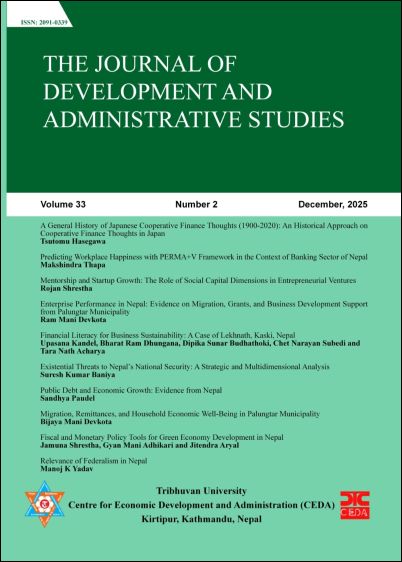
Public Debt and Economic Growth: Evidence from Nepal
Keywords:
ARDL bounds test, Cointegration, Fiscal policy, Economic growth, Public debtAbstract
This research aims to investigate the effects of public debt on economic growth in Nepal based on time-series information covering the period of 1985/86 to 2023/24. It uses the Autoregressive Distributed Lag (ARDL) bounds-testing to examine the long and short-run relationships between the elements of the public debt and the economic performance. The continued fiscal deficits and the resulting increase in dependence of domestic and foreign borrowing to meet development spending require a thorough insight into the dynamics of debt-growth to formulate effective policies in Nepal. The results obtained empirically indicate a high cointegration of the variables and the F-statistic value of 6.847 is above critical values at all standard levels of significance. The long-term outcomes indicate that the internal debt is positively and statistically significantly correlated with the economic growth (coefficient: 0.28), which means that domestic borrowing plays an effective role in supporting the economic development with productive investments. In contrast, external debt is associated with growth (coefficient: -0.21), which suggests the possibility of debt -overhang and ineffective use of foreign borrowing. The relationship between export performance and economic growth is positive (coefficient: 0.47) and it is important to note that trade plays a significant role in long-run economic growth. According to the error-correction model, the rate of adjustment is moderate (17 percent per year) which implies that short run disequilibria are corrected quite slowly. This study contributes to understanding public debt dynamics and provides evidence-based policy implications for sustainable debt management in the Nepalese context.
Downloads
Published
How to Cite
Issue
Section
License
The copyright of the accepted articles is reserved by the Centre for Economic Development and Administration (CEDA), Tribhuvan University (TU). No part of the article published in this journal should be reproduced except provided by the law currently in force without the written consent of the centre.

