
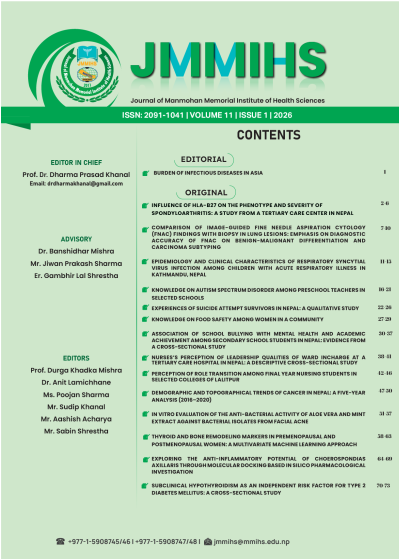
Thyroid and Bone Remodeling Markers in Premenopausal and Postmenopausal Women: A Multivariate Machine Learning Approach
Keywords:
Endocrinology, Clinical Biochemistry, Women’s Health, Menopause Studies, Bone Metabolism, Thyroid Disorders, Laboratory Medicine, Machine Learning in Medicine, Biomedical Data ScienceAbstract
Introduction: Menopause induces significant hormonal shifts that may impact thyroid function and bone metabolism. This study aimed to compare thyroid profile (FT3, FT4, and TSH) and bone remodeling (serum calcium, phosphorus, and ALP) markers between premenopausal and postmenopausal women and to examine their predictive ability via multivariate and machine learning methods.
Method: This cross-sectional study was performed among 178 women (89 premenopausal, 89 postmenopausal) attending Manmohan Memorial Teaching Hospital (MMTH), Kathmandu, Nepal. Serum levels of FT3, FT4, TSH, calcium, phosphorus, and ALP were estimated using standard methods. Statistical analyses were carried out by using Mann‒Whitney U tests, Spearman correlations, MANOVA, PCA, ANCOVA, and classification models such as logistic regression, LDA, SVM, and random forest.
Result: Postmenopausal women had markedly higher TSH and ALP levels, wereas lower serum calcium and phosphorus levels. MANOVA revealed a significant multivariate effect of menopausal status (Wilks’λ= 0.6818, p <0.001). Furthermore, the data were analyzed via machine learning models such as PCA, logistic regression and random forest. PCA revealed partial group separation. Among the different classification models, random forest performed better, with 81% accuracy, whereas LDA and logistic regression attained 78% accuracy. ALP and serum calcium were the most discriminative features. ANCOVA revealed that age, rather than menopausal status, significantly predicted calcium levels. A partial correlation confirmed a positive association between FT4 and calcium independent of age.
Conclusion: Menopausal status significantly affects the levels of thyroid and bone remodeling markers. ALP and calcium serve as strong discriminators of the menopausal state. Integrating endocrine and bone biomarkers with multivariate and machine learning models improves diagnostic insight into menopause-related physiological changes.
Downloads
Published
How to Cite
Issue
Section
License
Copyright (c) 2026 Rajesh Kumar Thakur, Rojiya Dhakal, Govardhan Joshi, Pabitra Bista, Anil Khadka, Sudip Khanal, Aashish Acharya, Sujan Gautam, Anit Lamichhane, Mahendra Prasad Bhatt

This work is licensed under a Creative Commons Attribution 4.0 International License.
Copyright on any research article in JMMIHS is retained by the author(s).
The authors grant JMMIHS a license to publish the article and identify itself as the original publisher.
The corresponding author is responsible for any conflict of interest between authors and others. The journal is not responsible for concepts, ideas, and views reflected in the articles published in the journal. The article will be retracted if any violation of an ethical issue is detected.
The articles in JMMIHS are licensed under a creative commons licensing .
This license permits use, distribution, and reproduction in any medium, provided the original work is properly cited, and it is not used for commercial purposes.

