
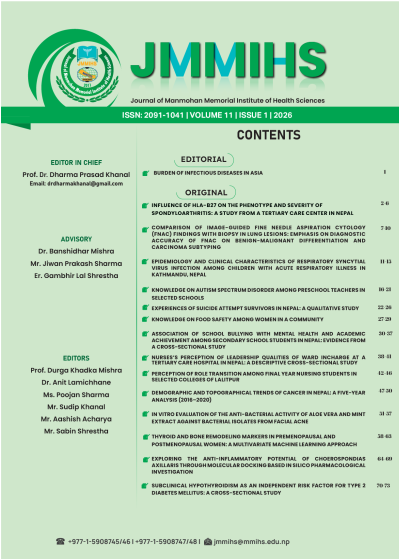
Comparison of Image-Guided Fine Needle Aspiration Cytology (FNAC) findings with Biopsy in Lung Lesions: Emphasis on diagnostic accuracy of FNAC on Benign-Malignant Differentiation and Carcinoma Subtyping
Keywords:
Image-guided FNAC, Biopsy, Non-small cell Lung carcinoma, Small-cell Lung carcinomaAbstract
Background: Accurate and timely diagnosis of lung cancer is essential for appropriate management. Fine-needle aspiration cytology (FNAC) is a minimally invasive diagnostic tool; however, its diagnostic performance in differentiating non-small cell lung carcinoma (NSCLC) from small cell lung carcinoma (SCLC) requires evaluation. This study aimed to assess the diagnostic accuracy of FNAC compared with biopsy in lung cancer patients for benign-malignant differentiation and carcinoma subtyping.
Methods: This hospital-based cross-sectional study was conducted from September-2024 to November-2025 at B.P. Koirala Memorial Cancer Hospital, Nepal. A total of 53 patients with radiologically detected lung lesions underwent image-guided (USG: Ultrasonography or CT: Computed Tomography), followed by histopathological biopsies. FNAC findings were compared with biopsy results, which served as the reference standard. The clinico-demographic data were collected. The statistical analysis was performed using STATA, and diagnostic performance metrics: sensitivity, specificity, positive predictive value (PPV), negative predictive value (NPV), and overall accuracy for FNAC in differentiating benign and malignant lesions, as well as SCLC and NSCLC. The associations between FNAC and biopsy results were assessed using the Chi-square test.
Results: Out of 53 total cases, FNAC differentiated into 6 benign and 47 malignant cases, whereas biopsy confirmed 10 as benign and 43 as malignant cases. FNAC demonstrated sensitivity of 100%, specificity of 60%, PPV of 91%, NPV of 100%, and overall accuracy of 92% in differentiating benign and malignant cases. The association was further assessed using chi square test (χ2: 23.4; p<0.01). Similarly, in cancer sub-typing, FNAC showed 11 SCLC and 32 NSCLC, whereas biopsy confirmed 16 cases as SCLC and 27 as NSCLC. FNAC demonstrated sensitivity of 44%, specificity of 85%, PPV of 64%, NPV of 72%, and overall accuracy of 70% in sub-typing SCLC and NSCLC. The association was further assessed using chi square test (χ2: 8.81; p=0.003).
Conclusion: Compared to biopsy, image-guided FNAC demonstrates high diagnostic accuracy in differentiating the lung lesions into benign and malignant and can therefore be used as a first-line diagnostic tool to facilitate early detection and management of lung malignancies. However, it is less reliable in carcinoma subtyping into SCLC and NSCLC; thus, histopathological examination is recommended for definitive subtyping.
Downloads
Published
How to Cite
Issue
Section
License
Copyright (c) 2026 Suraj Raj Uprety, Greta Pandey, Shankar Bastakoti, Nandita Jha, Ranjita Singh, Prerana Gautam, Prajita Bhandari, Brijesh Shrestha and Kripesh Shrestha

This work is licensed under a Creative Commons Attribution 4.0 International License.
Copyright on any research article in JMMIHS is retained by the author(s).
The authors grant JMMIHS a license to publish the article and identify itself as the original publisher.
The corresponding author is responsible for any conflict of interest between authors and others. The journal is not responsible for concepts, ideas, and views reflected in the articles published in the journal. The article will be retracted if any violation of an ethical issue is detected.
The articles in JMMIHS are licensed under a creative commons licensing .
This license permits use, distribution, and reproduction in any medium, provided the original work is properly cited, and it is not used for commercial purposes.

