
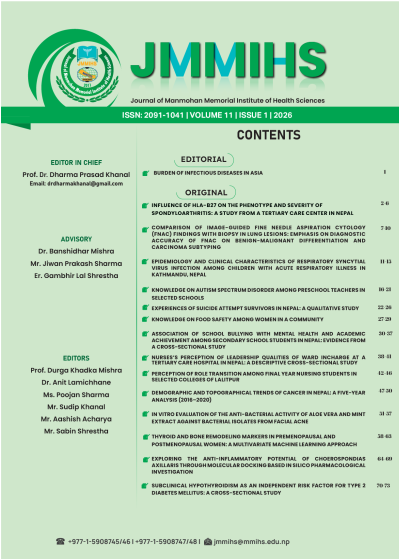
Association of School Bullying with Mental Health and Academic Achievement among Secondary School Students in Nepal: Evidence from a Cross-Sectional Study
Keywords:
academic achievement, anxiety, cross-sectional study, Depression, School Bullying, Mental Health, NepalAbstract
Introduction:Bullying in school settings is no longer viewed only as a behavioural concern; it also shapes students’ psychological well-being and their experience of learning. It generally involves repeated negative interactions among peers within relationships marked by unequal power. Such experiences are often linked with emotional strain, particularly symptoms of anxiety and depression, and may also influence students’ engagement with academic activities. Although these relationships have been explored in many contexts, analytically grounded evidence from Nepal remains limited. This study therefore examines how school bullying is associated with mental health and academic achievement among students in community secondary schools.
Methods: A cross-sectional analytical design was used. The study included 411 students selected through a multi-stage sampling process. Data were collected using a structured, self-administered questionnaire developed with reference to the Olweus bully–victim framework and adapted to the local school context. The instrument assessed bullying involvement (perpetration and victimization), symptoms of depression and anxiety, and indicators of academic achievement. The data were analysed using descriptive statistics, correlation analysis, and multivariate linear regression techniques.
Results: A considerable proportion of students reported involvement in bullying, either as victims or perpetrators. Approximately one-quarter of participants exhibited moderate to elevated levels of anxiety and depressive symptoms, with a strong positive correlation observed between the two conditions. Both the frequency and severity of victimization were significantly associated with mental health outcomes, indicating higher levels of psychological distress with increasing exposure. Bullying perpetration showed a similar pattern. Academic achievement demonstrated a modest negative association with victimization, with victimization frequency showing a statistically significant relationship, while other bullying-related variables were not significantly associated.
Conclusion: The study points to a clear association between school bullying and adverse mental health outcomes among adolescents, while its relationship with academic achievement appears comparatively weaker. Addressing bullying in school settings therefore requires attention not only to behaviour but also to students’ psychological well-being. Approaches that support early identification, strengthen teacher response, and incorporate basic mental health support mechanisms may help reduce its impact.
Downloads
Published
How to Cite
Issue
Section
License
Copyright (c) 2026 Krishna Subedi, Bhimsen Devkota

This work is licensed under a Creative Commons Attribution 4.0 International License.
Copyright on any research article in JMMIHS is retained by the author(s).
The authors grant JMMIHS a license to publish the article and identify itself as the original publisher.
The corresponding author is responsible for any conflict of interest between authors and others. The journal is not responsible for concepts, ideas, and views reflected in the articles published in the journal. The article will be retracted if any violation of an ethical issue is detected.
The articles in JMMIHS are licensed under a creative commons licensing .
This license permits use, distribution, and reproduction in any medium, provided the original work is properly cited, and it is not used for commercial purposes.

