
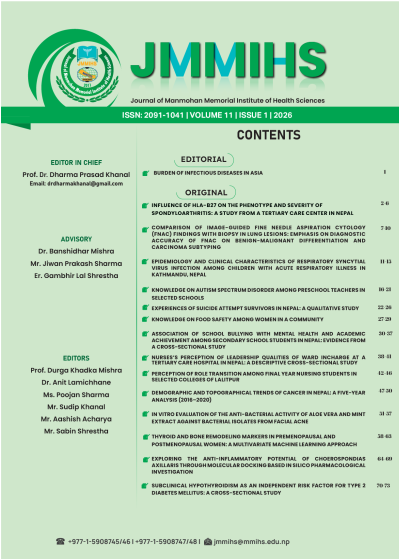
Subclinical Hypothyroidism as an Independent Risk Factor for Type 2 Diabetes Mellitus: A Cross-Sectional Study
Keywords:
Sub Clinical Hypothyroidism, Type 2 Diabetes Risk, DyslipidemiaAbstract
Introduction: Type 2 Diabetes Mellitus (T2DM) is a progressive metabolic disorder characterized by insulin resistance and impaired insulin secretion. Subclinical hypothyroidism (SCH), defined by elevated thyroid-stimulating hormone (TSH) with normal circulating thyroid hormones, has been increasingly linked to metabolic dysregulation that may contribute to T2DM risk. This study aimed to assess biochemical alterations and evaluate the association between SCH and T2DM risk.
Method: A cross-sectional study was conducted at Manmohan Memorial Teaching Hospital, Kathmandu, involving 399 participants, comprising 272 euthyroid individuals and 127 individuals with SCH. Fasting Blood Glucose (FBS), lipid profile, and thyroid function parameters using standardized automated analyzer and chemiluminescence immunoassay methods. Statistical analysis was performed using SPSS 26, including independent t-tests, correlation analysis, and multinominal logistic regression, with statistical significance set at p < 0.05.
Result: Females showed a higher prevalence of SCH compared to males. Compared with euthyroid individuals, SCH subjects had significantly higher VLDL levels (p=0.018), lower FT3 and FT4 levels (p=0.001 and p<0.001), and markedly elevated TSH levels (p<0.001). Other lipid and glucose parameters showed no significant differences. In SCH cases, TSH showed a significant positive correlation with fasting blood sugar(r=0.199; p<0.001). Multinomial logistic regression revealed that triglycerides, FT4, and TSH were significant predictors of glycemic status. Importantly, SCH was independently associated with higher odds of diabetes compared to euthyroid individuals (AOR = 3.98, 95% CI: 2.23–7.09, p = <0.001).
Conclusion: SCH is associated with altered thyroid function, dyslipidemia, and increased risk of T2DM. Early detection and monitoring of thyroid dysfunction may help in identifying individuals at higher risk of metabolic complications and diabetes development.
Downloads
Published
How to Cite
Issue
Section
License
Copyright (c) 2026 Anit Lamichhane , Susmita Humagain, Anil Khadka , Rabina Maharjan , Sudip Khanal, Aashish Acharya, Sujan Gautam, Mahendra Prasad Bhatta

This work is licensed under a Creative Commons Attribution 4.0 International License.
Copyright on any research article in JMMIHS is retained by the author(s).
The authors grant JMMIHS a license to publish the article and identify itself as the original publisher.
The corresponding author is responsible for any conflict of interest between authors and others. The journal is not responsible for concepts, ideas, and views reflected in the articles published in the journal. The article will be retracted if any violation of an ethical issue is detected.
The articles in JMMIHS are licensed under a creative commons licensing .
This license permits use, distribution, and reproduction in any medium, provided the original work is properly cited, and it is not used for commercial purposes.

