
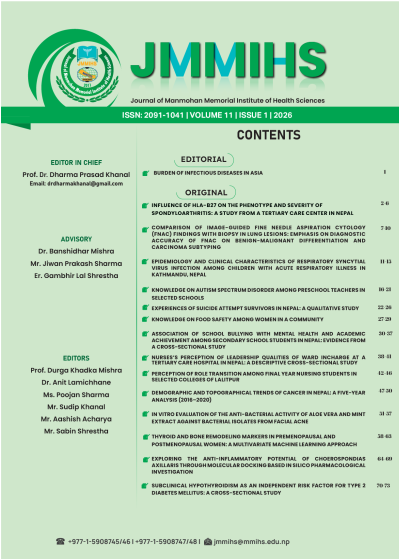
Influence of HLA-B27 on the Phenotype and Severity of Spondyloarthritis: A Study from a Tertiary Care Center in Nepal
Keywords:
Axial spondyloarthritis, HLA B27, Clinical phenotype, DactylitisAbstract
Introduction: Spondyloarthritis is a group of chronic inflammatory disorders characterized by shared clinical and genetic features, commonly involving the axial skeleton and strongly associated with HLA-B27. However, the clinical profile and disease severity of HLA-B27-negative axial spondyloarthritis remains poorly defined, particularly in South Asian populations. This study aimed to evaluate the association between HLA-B27 status and clinical phenotype, disease activity, functional status, inflammatory markers, and radiographic severity in Nepalese patients
Method: We conducted a cross-sectional study of adults with spondyloarthritis classified according to the ASAS 2009 criteria at a tertiary referral center in Kathmandu between October 16, 2025 to April 15, 2026. Clinical features, laboratory parameters, disease activity indices, and radiographic findings were compared between HLA-B27-positive and HLA-B27-negative groups. Multivariate logistic regression was performed to identify independent associations.
Result: Out of 193 screened patients, 166 were included. The majority were male (80.3%), with a median age of 34 years. HLA-B27 was positive in 83.7% of patients. HLA-B27-negative patients presented at an older age (41 vs. 34 years) and had later symptom onset (32 vs. 25 years) compared to HLA-B27-positive patients. Family history was more common in HLA-B27-positive patients (32.4%, p=0.06). Dactylitis was significantly more frequent in HLA-B27-negative patients (33.3% vs. 8%, p=0.001) and remained independently associated (adjusted OR 6.25, 95% CI 1.9–20, p=0.002). No significant differences were observed in disease activity, inflammatory markers, or radiographic findings.
Conclusion: HLA-B27 positivity was associated with earlier disease onset, whereas HLA-B27-negative patients exhibited more peripheral features, particularly dactylitis, with similar overall disease severity. Further longitudinal studies are needed to validate these findings.
Downloads
Published
Issue
Section
License
Copyright (c) 2026 Prabin Khatri, Ravi Shukla , Raj Adhikari , Puja Shrestha and Aabishkar Subedi

This work is licensed under a Creative Commons Attribution 4.0 International License.
Copyright on any research article in JMMIHS is retained by the author(s).
The authors grant JMMIHS a license to publish the article and identify itself as the original publisher.
The corresponding author is responsible for any conflict of interest between authors and others. The journal is not responsible for concepts, ideas, and views reflected in the articles published in the journal. The article will be retracted if any violation of an ethical issue is detected.
The articles in JMMIHS are licensed under a creative commons licensing .
This license permits use, distribution, and reproduction in any medium, provided the original work is properly cited, and it is not used for commercial purposes.

