
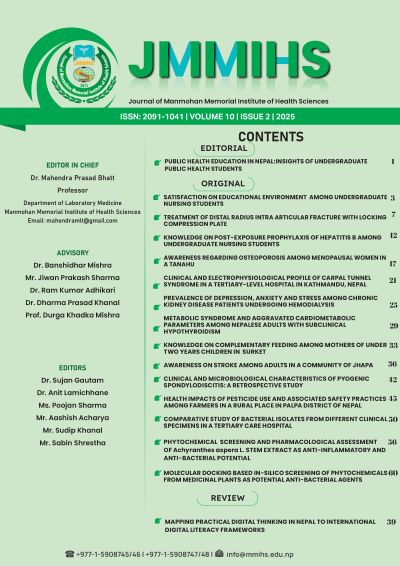
Mapping Practical Digital Thinking in Nepal to International Digital Literacy Frameworks
Keywords:
Mapping, Digital Thinking, Digital LiteracyAbstract
Nepal is shifting from traditional, intuition-based workflows to digitally driven approaches in governance and healthcare. Digital thinking, encompassing competencies such as data-driven decisions, task automation, mobile-first and user-centered design, cloud collaboration, remote work, predictive analytics, digital security, creativity, adaptability, networked decision-making, and sustainability, provides a framework for this transformation. This narrative review examines the adoption and challenges of these dimensions in Nepal, highlighting their potential to improve public health, administrative efficiency, and citizen engagement. Mapping these practical dimensions to DigComp 2.1 and United Nations Educational, Scientific and Cultural Organization (UNESCO) Digital Literacy Framework offers a structured approach for guiding policy and practice. Addressing gaps in literacy, infrastructure, and cybersecurity can accelerate Nepal’s digital transformation and enhance health outcomes.
Downloads
Published
Issue
Section
License
Copyright on any research article in JMMIHS is retained by the author(s).
The authors grant JMMIHS a license to publish the article and identify itself as the original publisher.
The corresponding author is responsible for any conflict of interest between authors and others. The journal is not responsible for concepts, ideas, and views reflected in the articles published in the journal. The article will be retracted if any violation of an ethical issue is detected.
The articles in JMMIHS are licensed under a creative commons licensing .
This license permits use, distribution, and reproduction in any medium, provided the original work is properly cited, and it is not used for commercial purposes.

