
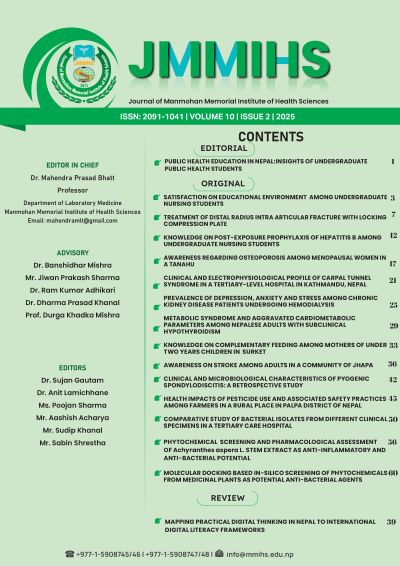
Metabolic Syndrome and Aggravated Cardiometabolic Parameters among Nepalese Adults with Subclinical Hypothyroidism
Keywords:
Subclinical hypothyroidism, Metabolic Syndrome, dyslipidemia, cardiovascular riskAbstract
Introduction: Subclinical hypothyroidism (SCH) and metabolic syndrome (MetS) both prevalent disorders associated with an elevated risk of cardiovascular disease (CVD). Thyroid hormones are crucial regulators of lipid and glucose metabolism, suggesting a significant pathophysiological link between SCH and the components of MetS. This study aimed to determine the burden of MetS among individuals with SCH in a Nepalese cohort.
Method: Cross-sectional study of 111 adults (≥18 years) undergoing thyroid function tests at Manmohan Memorial Teaching Hospital, Kathmandu (October 2021–March 2022). Participants were classified as euthyroid (n=35), SCH (n=57), or hyperthyroid (n=19). Blood pressure, BMI, and WC were measured, and biochemical parameters FBS, lipid profile, and Thyroid profile were estimated by a fully automated biochemistry analyzer and chemiluminescence immunoassay. MetS was defined according to the NCEP ATP III criteria. Analysis used done in SPSS v23 using ANOVA, post-hoc tests, t-tests, and Pearson’s correlation (p<0.05).
Results: Subclinical hypothyroidism exhibited dyslipidemia (elevated TC, TG, LDL-C; reduced HDL-C) and higher BMI versus euthyroid and hyperthyroid groups (p<0.01). Among thyroid disorders, the majority (71.05%) of the cases were with subclinical hypothyroidism (SCH). The overall incidence of MetS was 27.9% where the incidence was higher (90.8%) among females and major (41.94%) affected age group was 36-55 years. The incidence of MetS was higher (35.18%) among SCH (35.18%) as compared to other thyroid disorders. SCH with MetS showed significantly elevated blood pressure, waist circumference, and adverse lipids (p<0.05) as compared to SCH without MetS. TSH was positively correlated with waist circumference (r = 0.325, p = 0.017), implicating TSH in promoting central obesity.
Conclusion: Subclinical hypothyroidism is strongly associated with an adverse cardiometabolic profile and a high burden of metabolic syndrome. The coexistence of SCH and MetS identifies individuals with the worst parameters, highlighting a critical subgroup for targeted intervention to reduce diabetes and CVD risk
Downloads
Published
Issue
Section
License
Copyright on any research article in JMMIHS is retained by the author(s).
The authors grant JMMIHS a license to publish the article and identify itself as the original publisher.
The corresponding author is responsible for any conflict of interest between authors and others. The journal is not responsible for concepts, ideas, and views reflected in the articles published in the journal. The article will be retracted if any violation of an ethical issue is detected.
The articles in JMMIHS are licensed under a creative commons licensing .
This license permits use, distribution, and reproduction in any medium, provided the original work is properly cited, and it is not used for commercial purposes.

