
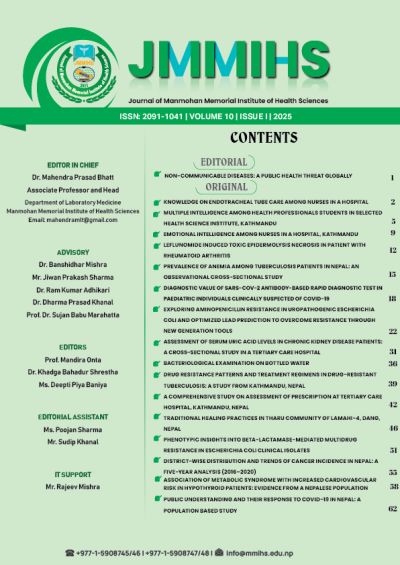
Phenotypic Insights Into Beta-Lactamase-Mediated Multidrug Resistance In Escherichia Coli Clinical Isolates
Keywords:
MDR E. coli, ESBL, MBL, AmpCAbstract
Introduction: The global rise of multidrug-resistant (MDR) bacteria is largely attributed to the production of β-lactamases, including extended-spectrum β-lactamases (ESBLs), metallo-β-lactamases (MBLs), and AmpC β-lactamases. This study aimed to evaluate the phenotypic characteristics of β-lactamase-producing MDR Escherichia coli isolates and assess their antibiotic resistance profiles.
Method: A cross-sectional study was conducted over six months (November 2021–April 2022) at Manmohan Memorial Teaching Hospital, Kathmandu. Clinical samples were processed using standard microbiological techniques to isolate E. coli. The Kirby-Bauer disk diffusion method was used for antimicrobial susceptibility testing. Phenotypic detection of ESBL, MBL, and AmpC β-lactamases was performed using the combined disk method.
Results: Out of 127 E. coli isolates, 55 (43.3%) were identified as MDR. Among these, 26 (47.3%) expressed β-lactamase activity: AmpC (34.54%), MBL (7.27%), and ESBL (5.45%). No co-existence of β-lactamases was observed. High resistance was noted against amoxicillin (100%), cefixime (90.9%), and cotrimoxazole (85.5%), whereas amikacin (90.9%) and meropenem (89.0%) showed strong effectiveness.
Conclusion: AmpC β-lactamase was the predominant resistance mechanism among MDR E. coli isolates. Early detection of β-lactamase production is crucial for effective infection control and to curb the spread of MDR pathogens.
Downloads
Published
How to Cite
Issue
Section
License
Copyright on any research article in JMMIHS is retained by the author(s).
The authors grant JMMIHS a license to publish the article and identify itself as the original publisher.
The corresponding author is responsible for any conflict of interest between authors and others. The journal is not responsible for concepts, ideas, and views reflected in the articles published in the journal. The article will be retracted if any violation of an ethical issue is detected.
The articles in JMMIHS are licensed under a creative commons licensing .
This license permits use, distribution, and reproduction in any medium, provided the original work is properly cited, and it is not used for commercial purposes.

