Anticipatory forest-fire risk governance in Nepal
Keywords:
Forest fire, Anticipatory governance, Disaster risk reduction, Fire preparedness, NepalAbstract
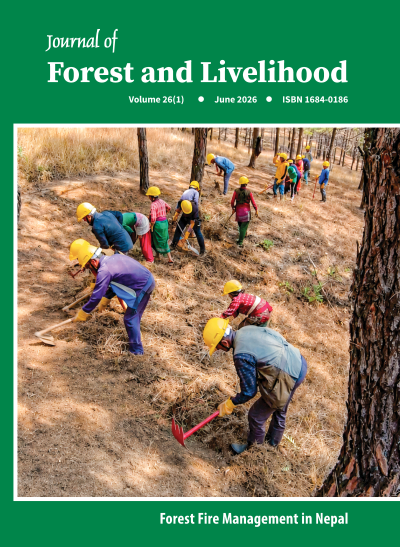
Nepal’s pre-monsoon forest fires are becoming increasingly frequent, widespread and socially consequential, damaging lives and livelihoods. However, responses remain largely reactive. These risks are compounded by institutional fragmentation and policy gaps that prevent timely and coordinated action. Drawing on disaster risk reduction principles, this perspective proposes an anticipatory approach to fire risk governance, emphasising the importance of community forestry institutions. In doing so, it combines empirical insights from Nepal with operational lessons from New South Wales and Victoria, Australia. Both cases highlight how forecast-based fire danger ratings function as decision triggers for agencies and communities. The Victorian case also illustrates how such triggers are embedded in the broader governance system. Together, these cases demonstrate that anticipatory governance is not about the forecast system alone, but about the systematic linkage of information to decision-making and behavioural response.
Downloads
Published
Issue
Section
License

This work is licensed under a Creative Commons Attribution-NonCommercial 4.0 International License.
CC-BY-NC: This license allows reusers to distribute, remix, adapt, and build upon the material in any medium or format for noncommercial purposes only, and only so long as attribution is given to the creator.

