Maintaining people-forest interactions is critical to managing forests fires in Nepal
Keywords:
Wildfires, Healthy forests, Sustainable forest management, Community engagement, Forest fuel reduction, Resilient forest landscapesAbstract
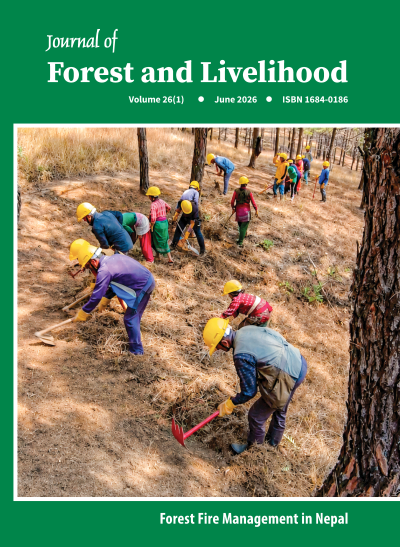
Forest fire is an important ecological process; however, it can cause ecological and societal harm due to anthropogenic mismanagement and natural adversities leading to long-term socio-economic and environmental consequences. Extreme forests fire events have increased worldwide over the last decade, and events in Nepal are consistent with this trend. Nepalese forestry practices have already set an example of successful forest management by communities and thus demonstrate precedent in effective community mobilisation. Recent studies suggest that local people’s participation in community forest management is declining consequently weakening forest-people relationships. Here, we argue on why Nepal should build upon its long legacy of people-forest interactions and strengthen community engagement as a key component of sustainable forest fire management. Synthesised evidence and experiences demonstrate that community-led fire management is among the most viable preventive approaches for reducing fuel loads in forest ecosystems. The Government of Nepal should therefore establish clear policies and strategic frameworks that enable forest scientists, private sectors and non-profits to contribute collaboratively toward the national goal of creating resilient forest landscape in the era of socio-ecological transition.
Downloads
Published
How to Cite
Issue
Section
License

This work is licensed under a Creative Commons Attribution-NonCommercial 4.0 International License.
CC-BY-NC: This license allows reusers to distribute, remix, adapt, and build upon the material in any medium or format for noncommercial purposes only, and only so long as attribution is given to the creator.

