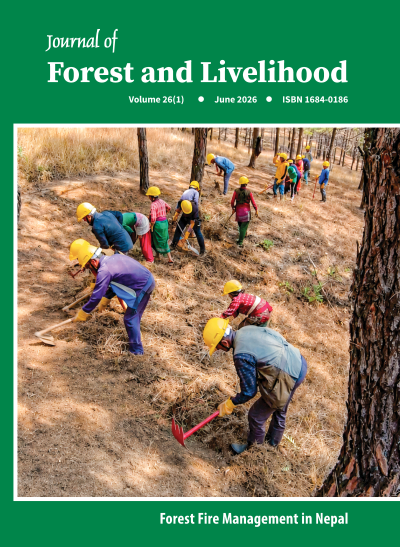
Assessment of forest fire incidences, causes, and management practices in Bagmati Province, Nepal
Keywords:
Bagmati province, Community-based approach, Fire risk, Forest fires, GISAbstract
Forest fires pose a growing environmental and socio-economic threat in Nepal, driven by both anthropogenic and natural factors. This study examines forest fire incidence, spatial risk patterns, causes, and management practices in Bagmati province using a mixed-methods approach. Spatial and temporal data from MODIS/FIRMS (2014 to 2024) were analysed in ArcGIS to generate a fire risk map using a weighted overlay model. Model validation was conducted using Kernel Density Estimation and Visible Infrared Imaging Radiometer Suite fire hotspots data. Qualitative data were collected through purposively sampled key informant interviews with 29 stakeholders from Community Forest User Groups (CFUGs) and Forest Officers, as well as three focus group discussions conducted in high-fire risk zones. The findings reveal that a total of 46,546 fire incidents were recorded in Bagmati Province during the study period, with 92.87 per cent occurring during the pre-monsoon season (March to May). Approximately 34 per cent of the province falls within very high fire risk zones, particularly in the districts of Sindhuli, Ramechhap, Makawanpur, and Chitwan. Human-induced factors dominated fire ignition, accounting for over 75 per cent of reported causes. Despite existing community forest institutions, fire management effectiveness remains constrained by limited resources, weak coordination, and lack of early warning systems. The lessons from the findings highlight the need for coordinated, community-centered technological innovations to strengthen institutional capacities and enhance policy implementation which are vital for reducing fire risks and fostering sustainable forest fire management in the region.
Downloads
Published
How to Cite
Issue
Section
License

This work is licensed under a Creative Commons Attribution-NonCommercial 4.0 International License.
CC-BY-NC: This license allows reusers to distribute, remix, adapt, and build upon the material in any medium or format for noncommercial purposes only, and only so long as attribution is given to the creator.

