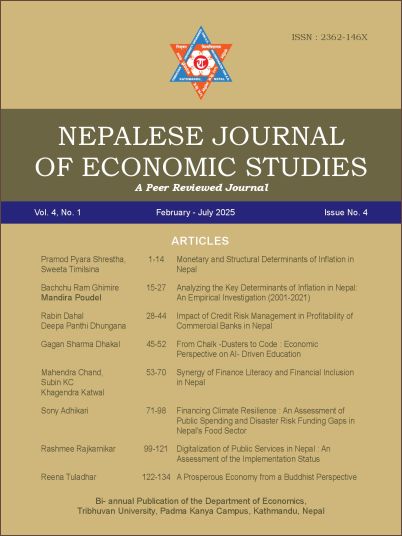
Analyzing the Key Determinants of Inflation in Nepal: An Empirical Investigation (2001-2021)
Keywords:
Inflation, remittances, money supply, Indian CPI, exchange rate peg, cointegrationAbstract
This study empirically examines the key determinants of inflation in Nepal from 2001 to 2021, focusing on both external and domestic macroeconomic factors. Using annual time-series data, the analysis employs Ordinary Least Squares (OLS) regression and Johansen cointegration tests to assess the impact of Indian inflation (INCPI), broad money supply (M2), remittance inflows (REM), government expenditure (GE), and imports (IMP) on Nepal’s Consumer Price Index (CPI). The results reveal that Indian CPI, remittances, and money supply have statistically significant positive effects on inflation, with elasticities of 0.40 percent, 0.097 percent, and 0.142 percent, respectively. Government spending and imports, however, exhibit insignificant short-run effects, though cointegration tests confirm their long-run influence. The study underscores Nepal’s vulnerability to imported inflation due to its fixed exchange rate regime and heavy trade dependence on India, while also highlighting demand-side pressures from remittance-fueled consumption and monetary expansion. Policy recommendations include tighter liquidity management, diversification of import sources, and channeling remittances into productive investments to mitigate inflationary pressures.
JEL Codes: E31, E51, F24, F41, O53
Downloads
Published
How to Cite
Issue
Section
License
Copyright (c) 2025 Department of Economics, Padma Kanya Multiple Campus, Tribhuvan University

This work is licensed under a Creative Commons Attribution-NonCommercial-NoDerivatives 4.0 International License.
This license enables reusers to copy and distribute the material in any medium or format in unadapted form only, for noncommercial purposes only, and only so long as attribution is given to the creator.

