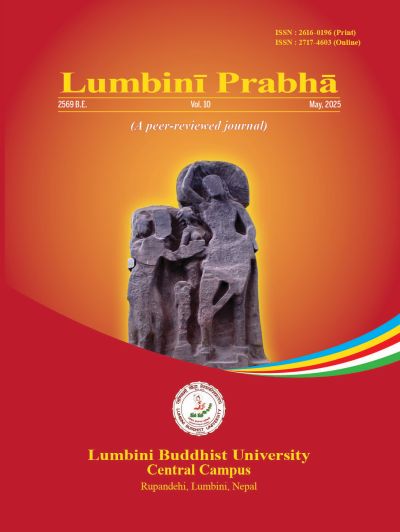
Depicting the Tirthaṇkaras and Buddhas in Art
Keywords:
Budda, Iconography and Iconology, Kāyotsarga, Symbolism, Tirthaṇkara, TrikāyaAbstract
The sixth century BCE is often regarded as the “Golden Period” for the evolution of
various philosophical developments worldwide. Among these, the two Śrāvaka traditions
viz. Jainism and Buddhism stand out as highly influential alongside other Vedic traditions
in the South Asian region. Although Jainism and Buddhism are considered nāstika in
nature due to their rejection of Vedic rituals, they have played significant roles in shaping
society and the world. Both religions maintained their core principles as they evolved.
Their founders, Mahāvira (also known as Nigaṇṭhanāthaputta) and Gautama Buddha,
left lasting impacts, leading to the global recognition of these traditions as Jainism and
Buddhism. Notably, they share the same historical timeline. However, both traditions
also acknowledge that their respective founders were not the first to contribute to their
teachings. Many Jinas and Buddhas preceded them, working for the welfare and spiritual
upliftment of the world. This respect for their predecessors is vividly depicted in the form
of images. The art of Nepal and India portrays the 24 Tirthaṇkaras of Jainism and various
forms of Buddhas, including human Buddhas, with rich symbolic meaning and influence.
This article seeks to identify the distinct features incorporated into the representations
of Tirthaṇkaras and Buddhas. It explores the Jain iconographic and iconological aspects
alongside the Buddhist depictions under the Trikāya doctrine. The term “Jain” originates
from the word “Jina,” meaning “those who have conquered the senses,” while “Buddha,”
derived from the root “Budh,” signifies “the awakened one.” Although these traditions
share certain similarities, their artistic depictions often differ. This article attempts to
address these discrepancies and provide a broader perspective on their iconography.