A Comparative Study of Magnetic Resonance Imaging and Arthroscopy in ACL and Meniscal Injuries
Keywords:
Anterior cruciate ligament, Arthroscopy, Magnetic resonance imaging, meniscusAbstract
BACKGROUND
Magnetic Resonance Imaging (MRI) has emerged as the primary diagnostic tool for assessing ligamentous and meniscal injuries of the knee. This study aimed to evaluate the accuracy of MRI findings compared to arthroscopy, considered the gold standard, in diagnosing knee injuries.
METHODS
A total of 83 patients presenting with knee injuries underwent clinical examination, MRI, and subsequent arthroscopy at our hospital. The arthroscopic findings were compared with MRI results, and statistical analysis was performed using the Statistical Package for the Social Sciences (SPSS) version 26. Sensitivity, specificity, positive predictive value (PPV), negative predictive value (NPV), and overall accuracy were calculated. A p-value of ≤0.05 was considered statistically significant.
RESULTS
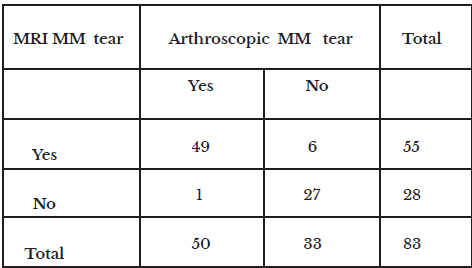
In this study, the sensitivity of MRI for detecting anterior cruciate ligament (ACL) tears was 96.6%, while it was 98% for medial meniscus (MM) tears and 81% for lateral meniscus (LM) tears. The specificity for ACL, MM, and LM tears was 92%, 81.8%, and 96.8%, respectively. The diagnostic accuracy for ACL, MM, and LM tears was 95.2%, 91.56%, and 92.8%, respectively.
CONCLUSION
This study demonstrated the high sensitivity and specificity of MRI in diagnosing ACL and meniscal tears. The findings support the routine use of MRI in diagnosing these injuries of the knee, especially when combined with a thorough clinical history and examination. MRI exhibits high accuracy in detecting meniscal and ACL tears, making it a valuable screening tool for therapeutic arthroscopy.
Downloads
Published
How to Cite
Issue
Section
License
Copyright (c) 2025 The Author(s)

This work is licensed under a Creative Commons Attribution-NonCommercial-NoDerivatives 4.0 International License.
CC BY-NC-ND This license allows reusers to copy and distribute the material in any medium or format in unadapted form only, for noncommercial purposes only, and only so long as attribution is given to the creator.

