Proximal Humerus Fractures among Patients Presenting with Humerus Fractures in the Emergency Department of a Tertiary Care Center- A Descriptive Cross-sectional Study
Keywords:
fall injury, Neer's classification, proximal humerus fracture, road traffic accidentAbstract
BACKGROUND
Proximal humerus fracture is a common injury, with recent studies demonstrating annual incidences ranging from 60.1 to 90.8 per 100,000 person-years. Early initiatives regarding its management with rehabilitation are essential to provide satisfactory functional outcomes. This study aims to determine the prevalence of proximal humerus fractures among adult patients in the emergency.
METHODS
This descriptive cross-sectional study was conducted at a tertiary care centre involving patients with proximal humerus fractures at the emergency department between January 1, 2020, and December 31, 2023. All adult patients diagnosed with the proximal humerus fracture were included in the study. Those with missing clinical records and radiographic images managed in other centres were excluded. The study was approved by B&B IRC (Ref number: B&B IRC-23-25)
RESULTS
Out of 2516 adult patients presented to the emergency department with fractures. 123 (4.89%) had proximal humerus fracture. A total of 109 patients were included in the final analysis. There were 60 (55.05%) males and 49(44.95%) females, with a mean age of 47.87 ± 15.00 years (range, 18 to 85 years). The right side was involved in 74 (67.89%), and the left side was involved in 35 (32.11%). A road traffic accident was seen in 63 (57.80 %) patients, followed by fall injury in 42(38.53%) and direct impact in 4 (3.67%). Open fracture was seen in 2 (1.83%) cases. Association with dislocation was seen in 9(8.26%) cases, and one was associated with nerve injury (axillary nerve injury).
CONCLUSION
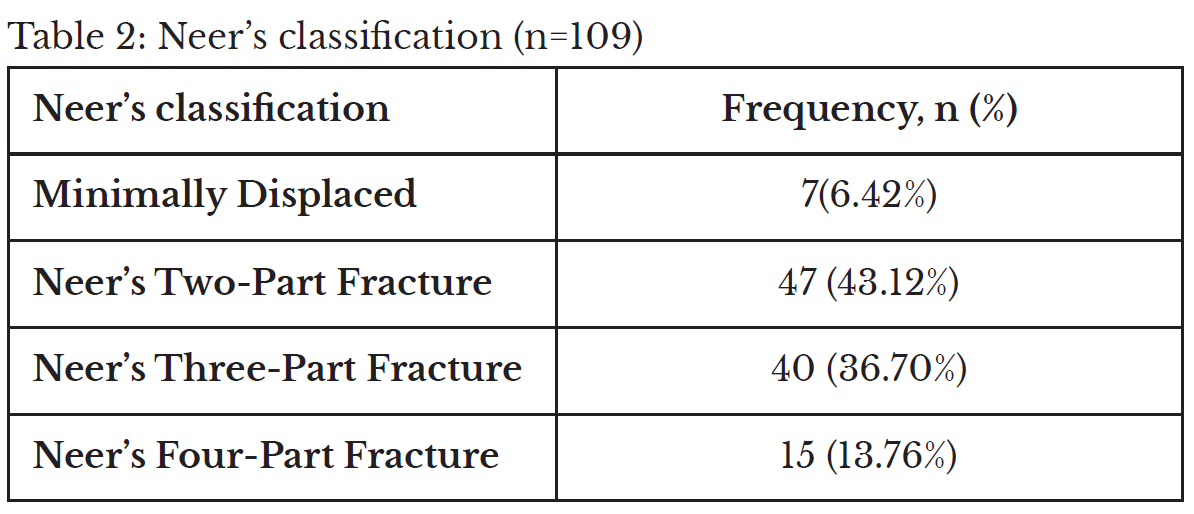
Proximal humerus fracture has a prevalence of 4.89% of all fractures presenting to an emergency department. It is common among males in the fourth decade of their life following road traffic accidents. Neer’s two-part fracture is the most common, followed by a three-part fracture.
Downloads
Published
How to Cite
Issue
Section
License
Copyright (c) 2025 The Author(s)

This work is licensed under a Creative Commons Attribution-NonCommercial-NoDerivatives 4.0 International License.
CC BY-NC-ND This license allows reusers to copy and distribute the material in any medium or format in unadapted form only, for noncommercial purposes only, and only so long as attribution is given to the creator.

