Comparison of Haglund Height and Angle in Persons with or without Insertional Achilles Tendinopathy
Keywords:
Insertional Achilles Tendinopathy, Haglund Deformity, Haglund Height, Haglund angleAbstract
BACKGROUND
Insertional Achilles tendinopathy (IAT) has been associated with Haglund deformity of the posterosuperior calcaneal tubercle. During surgical treatment of IAT, excision of the Haglund deformity is being performed as a routine, which adds morbidity. We wanted to find out if is that really necessary or not by comparing the Haglund height and angle between patients with IAT and the control group in our population.
METHODS
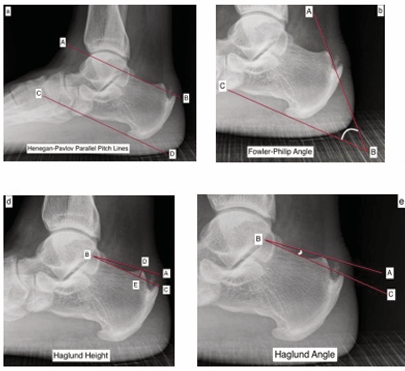
A cross-sectional study was performed on 68 patients in the department of Orthopaedics and Trauma from November 2023 to April 2024 after ethical approval (Ref no. 27-080/081). Measurement of Haglund height and angle was performed in the hospital PACS system. Other relevant angles and lines were also measured. Other important X-ray findings were also noted.
RESULTS
The mean Haglund height and Haglund angle in the IAT group were 3.97±1.65 mm and 7.35±3.15° respectively. In the control group, the mean Haglund height and Haglund angle were 2.99±1.33 mm and 5.38±2.49° respectively. Both Haglund height and angle were statistically significant when compared between groups. Also, the presence of posterior heel spur, calcification over the tendoachilles, and sclerosis of the posterior calcaneal tuberosity in x-ray was statistically significant in comparison between the two groups.
CONCLUSION
Our study concludes that Haglund deformity has a role in the pathogenesis of IAT, and its excision might be justified. The presence of posterior heel spur, calcification over the tendoachilles, and sclerosis of the posterior calcaneal tuberosity are key features in the x-ray of IAT.
Downloads
Published
How to Cite
Issue
Section
License
Copyright (c) 2025 The Author(s)

This work is licensed under a Creative Commons Attribution-NonCommercial-NoDerivatives 4.0 International License.
CC BY-NC-ND This license allows reusers to copy and distribute the material in any medium or format in unadapted form only, for noncommercial purposes only, and only so long as attribution is given to the creator.

