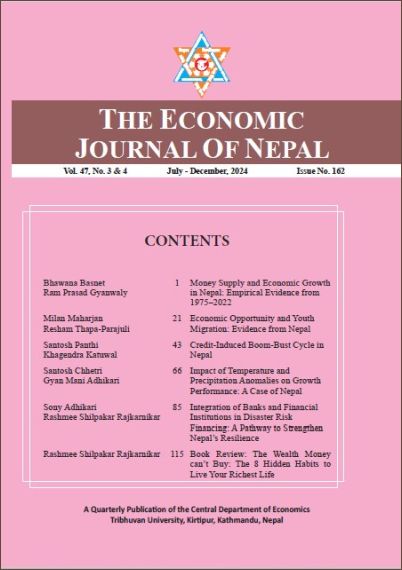
Impact of Temperature and Precipitation Anomalies on Growth Performance: A Case of Nepal
Keywords:
Climate change, Economic growth volatility, Temperature anomalies, Precipitation variabilityAbstract
This paper examines the role of climate variability in determining the volatility of economic growth in Nepal by analyzing the correlations between temperature and precipitation variability and the economy's overall performance. We compared 1990-2024 data using Vector Autoregression (VAR) and Vector Error Correction Model (VECM), and used four significant variables: GDP growth, temperature anomalies, precipitation anomalies, and government debt. In our strategy, climate factors are viewed as inputs to production, alongside the traditional macroeconomic indicators. The results indicate several significant trends. Although the association between temperature changes and decreased GDP growth appears positive, it is not significant enough to conclude that a temperature rise impairs Nepal's economic performance. Nevertheless, the study found a statistically significant, close correlation between temperature variation and higher government debt. It noted that climate pressures are likely to affect Nepal's economy not only through direct productivity losses but also through fiscal channels. Precipitation is the primary climatic phenomenon influencing changes in the economy. The variance decomposition indicates that rainfall variation explains around 19 per cent of GDP changes, far more than the roles of temperature variations or debt levels. This highlights Nepal's specific susceptibility to monsoon patterns, as it relies on rain-based agriculture and hydropower. Interestingly, a negative relationship is observed between precipitation and GDP growth in the long-run analysis, which could be counterintuitive. This is probably indicative of extreme rainfall resulting in floods and infrastructure damage, or of a complex adaptation process underway over a long period of time. The implications of these findings are significant to policymakers, and the first is that climate concerns should be incorporated in fiscal planning and macroeconomic forecasts. The results underscore the need to establish fiscal resilience through climate-sensitive contingency funds and acknowledge that rainfall variability is a critical factor driving economic instability in Nepal.
Downloads
Published
How to Cite
Issue
Section
License
© Cedecon-TU

