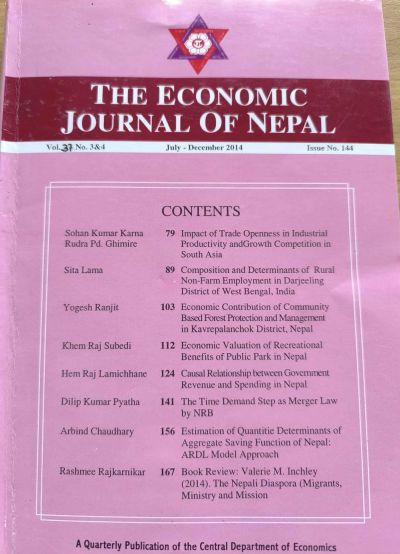
Estimation of Quantitative Determinants of Aggregate Saving Function of Nepal: ARDL Model Approach
Keywords:
Saving Function, Bound Test, Short Run Dynamics, Stability TestAbstract
This paper gives the third degree to estimate the quantitative determinants of aggregate saving function of Nepal, selecting the sample size from 1980 to 2014. Auto regressive distributive lag model, also known as dynamic regression model, reveals that real income, real exchange rate, real interest rate and inflation rate are the significantly determinants of the aggregate long run saving function of Nepal. Whereas, real income, interest rate and interest rate are significantly derived as short run determinants of saving function. Furthermore, bound testing shows the existence of long run association among the variables. MPS is recorded greater than unity in both saving function. Similarly, real exchange rate determines the inverse relation between real saving and depreciation in short run, but it is just opposite in the long run. The elasticity coefficient of real exchange rate has greater than unity with positive sign; it proves that there is positive relationship existed between real saving and depreciation in the long run. Also, there is found substitution effect of real interest rate on real saving with significantly low coefficient. Inflation rate postulates positive impact on real saving with very low coefficients in the long run only. The speed of adjustment parameter is recorded 79.98 percent each annum. Finally, CUSUM and CUSUMQ tests show the presence of stability of long run and short run dynamics of the model at significant level of 5 percent.
Downloads
Published
How to Cite
Issue
Section
License
© Cedecon-TU

