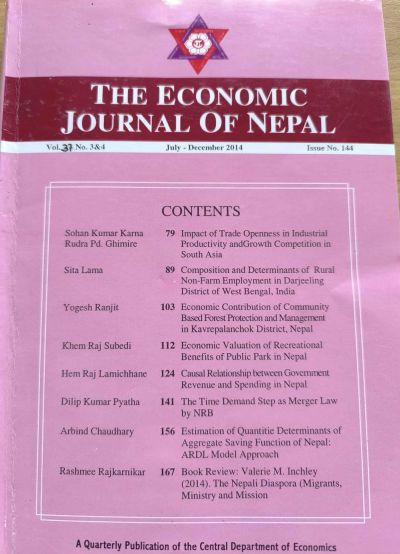
The Time Demand Step as Merger Law by NRB
Keywords:
Efficiency, Productivity, Data envelopment analysis, Commercial banksAbstract
This study checks and tries to determine the impact of financial institutions mergers on efficiency and productivity of commercial banks in Nepal for the period from 2008 until 2014. The study uses a simply theoretical approach and examines efficiency Productivity based on some major indicators like paid up capital, non performing loan, spread rate. Amongst the findings are that banks exhibit higher efficiency scores after the merger and that the merged banks and some foreign banks are more efficient than the local banks. For productivity, the banks had improved in both periods, before and after the merger. However, it is the local banks that improved the most after the merger. The main sources of productivity were sound financial administration, improved in internal financial backup, reduction in cost of operation and technical change or innovation. The findings support the existing policy of having larger domestic banks in terms of size and internal strength of merged banks.
Downloads
Published
How to Cite
Issue
Section
License
© Cedecon-TU

