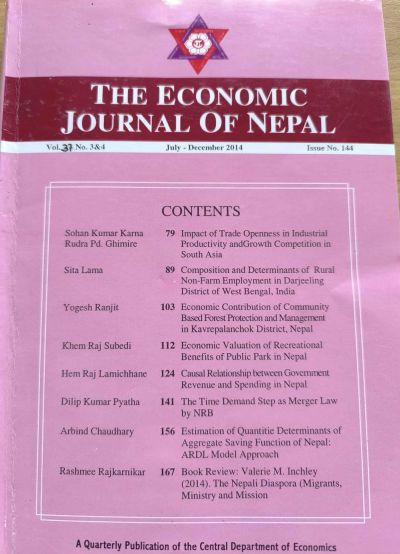
Causal Relationship between Government Revenue and Spending in Nepal
Keywords:
Public Revenue Income, Expenditure, Granger Causality, Co- integration, Augmented Dickey-Fuller TestAbstract
The revenue income and expenditure of the government of Nepal is reviewed and analyzed. Service and function wise current expenditure and capital expenditure and tax and non-tax revenue is focused for the study. The major sources of revenue of government of Nepal are tax on income, profits and capital gain, taxes on payroll and workforce, tax on property, tax on goods and services, tax on international trade and transaction and non-tax revenues are collected from property income, sale of goods and services, penalties, fines and forfeiture etc. The main objective of the study is to examine the causal relationship between government revenue and spending/expenditure of government of Nepal. Augmented Dickey-Fuller test (ADF testing) is applied to examine the unit root test. Granger Causality Tests (VAR approaches) is used to see the causality of the variables. The model is not suffering from serial correlation in residual. It does not have heteroskedasticity and residuals are normally distributed. The study found that the variables are co-integrated and have long run association among all three variables i.e. total expenditure. tax revenue and non-lax revenue. Therefore the restricted VAR that is Vector Error Correction Model (VECM) is run. It is also found that there is long run causality from tax and non-tax revenue to total expenditure. The total expenditure log I and lag 2 can jointly cause non-tax revenue meaning that total expenditure can affect the non-tax revenue.
Downloads
Published
Issue
Section
License
© Cedecon-TU


