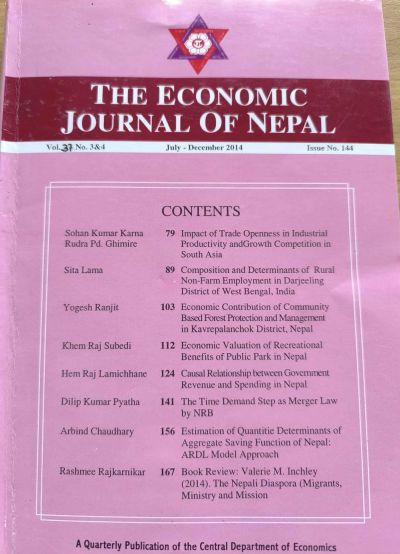
Economic Valuation of Recreational Benefits of Public Park in Nepal
Keywords:
Non-market Valuation, Individual Travel Cost Method, Consumer Surplus, Public good, Count Data, C31, D11, D61, H41, Q26, Q56Abstract
This paper investigates benefit cost ratio and condition of consumers' surplus from recreational public park in Nepal. The main objective of this study is to estimate the recreational benefits of Tikapur Banglow Park (TBP), calculation of consumers' surplus per visitor per trip of individual visitors and estimation of benefit cost ratio of the Park. The Individual Travel Cost Method (ITCМ) has been employed to capture the non-market benefits of the Park. The study is based on the survey of 108 visitors of Tikapur Banglaw Park(TBP) during mid March to mid April 2014. The Poisson regression model has been used to estimate consumer surplus of the visitors. The study shows that visit rate of visitors of Park is inversely correlated with travel cost and age of the visitors and positively correlated with household income of the visitors. The mean consumer's surplus per visitor per trip is estimated to be about NPR 2475. The aggregated consumer surplus for the annual park visitors calculated to be NPR 351 million. The estimated opportunity cost of the Park in terms of agricultural production is about NPR 8.85 million per annum. The total benefit is NPR 355 million and total cost is NPR 13 million per annum. The benefit cost ratio is 27.43. The study clearly finds that the Tikapur Banglaw Park generates significantly higher level of social welfare. Therefore, Tikapur Municipality should formulate timely project intervention to upgrade quality of ТBР.
Downloads
Published
How to Cite
Issue
Section
License
© Cedecon-TU

