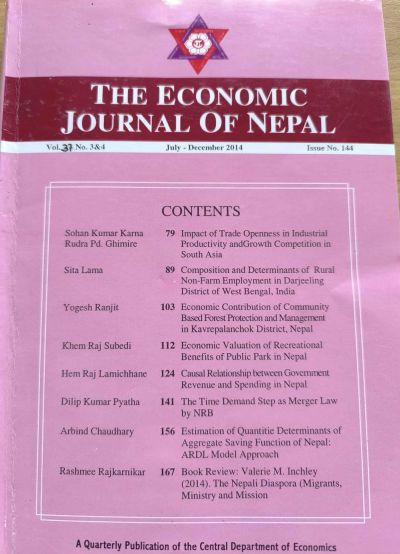
Economic Contribution of Community Based Forest Protection and Management in Kavrepalanchok District, Nepal
Keywords:
people participation, income and employment generation, community forests, forest productsAbstract
This paper deals with economic contributions of community participation in forest protection and management program in the rural area of mid-hills district of Nepal. The economic benefits are the use of timber, various types of non-timber forest products and employment generation. Forests also become one of the important sources for income and employment generation to the people living in and around the forests. It contribution's to GDP is very nominal. The major goal of the program is to achieve sustainable management of forests and forest resources by converting accessible national forests into community forests. In Nepal, there were various types of informal traditional forest protection and management activities undertaken by the various indigenous local committees even without any formal forest management policies of the government. But since mid of 1970's, government started a formal program of community participation in forest protection and management and still continue to date. A multiple log linear regression model is used along with t-test, F-test and D-W test. The study reached to the conclusion that forest condition (quality and quantity) of most community forests in the study area is improved after handing over forests to local users. As people are highly dependent upon forests and forest products for income and employment generation, all household members of selected FUGs are generating income and employment from the community forests.
Downloads
Published
How to Cite
Issue
Section
License
© Cedecon-TU

